(CLEVELAND, Ohio) — After more than 20 years, a rape survivor was finally able to confront her attacker, her words read by a victim advocate:
“I felt so violated and filthy,” the advocate read before the March sentencing of assailant Kenneth Edmond. “It was a sadness and pain that I couldn’t wash off.” Her victim-impact statement continued, “The fear of being attacked by this man again all these years has followed me through my whole adult life.”
The same apprehension lingers for other rape survivors in Cuyahoga County, many wondering if justice will ever be served for them.
According to an analysis of FBI data by the Justice Center of the Council of State Governments published by Cleveland.com, the national clearance rate for reported rape cases from 2022 to 2024 was 26.5%, but in Ohio, the rate was only 13.5%. (A case is cleared when it is either closed or resolved.) In 2023 in Ohio, there were 5,544 rape offenses reported to police, according to the center.
With continued advancements in forensic science, rapists who once thought they had gotten away with their crimes are now being exposed years and, in some cases, decades later.
Determined to resolve these cases, Ohio officials are confronting the state’s low clearance rate head-on and pushing for change, one case at a time.
In 2020, the Cuyahoga County Prosecutor’s Office (CCPO) formed the Genetic Operations Linking DNA (GOLD) Unit using grants awarded to the Sexual Assault Kit Task Force (SAKFT) by the Department of Justice’s National Sexual Assault Kit Initiative (DOJ SAKI).
By reevaluating evidence and applying new forensic tools, the GOLD Unit aims to close violent cold cases.
Two years after the program’s launch, the CCPO announced a new game-changing initiative. In a press release, Cuyahoga County Prosecutor Michael C. O’Malley said the GOLD Unit would receive $250,000 from the Law Enforcement Training Funds (LETF), allocated for forensic genetic genealogy (FGG), a way of finding offenders through a trail of family DNA.
FGG is a new investigative tool that combines advanced DNA analysis with traditional methods.
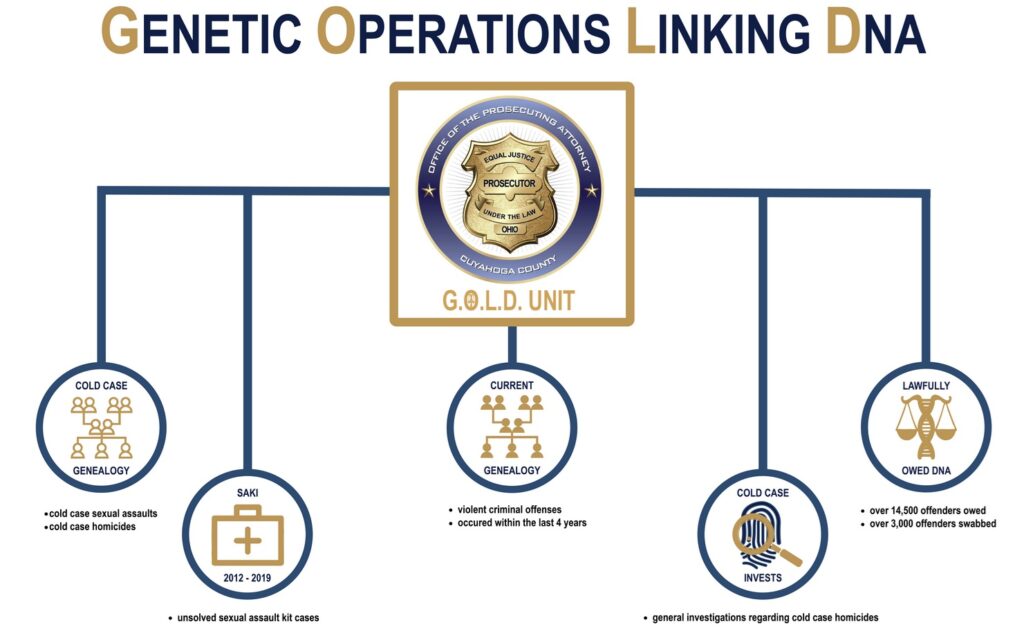
Graphic illustrates five initiatives the GOLD Unit uses to investigate cold cases. [Photo credit: Cuyahoga County Prosecutor’s Office]
Investigators then use those markers to search public databases to find relatives “as far back as third-cousins of an individual,” he said.
In addition to FGG, investigators rely on Familial DNA Searching (FDS), a method that has been around for more than 20 years. Once obtained, the DNA profile is uploaded to a public database and compared to others, often through the Combined DNA Index System (CODIS).
Although the objective is to find a perfect match, investigators often find only a partial match, indicating a relative. From here, police can explore DNA in a family tree to home in on a suspect.
While FDS relies primarily on partial matches, FGG expands the search dramatically, reaching across expansive family trees.
But by allowing law enforcement to search through millions of genetic profiles, it can introduce a statistical pitfall known as “ascertainment bias.”
Like winning the lottery, if “there’s a one-in-a-million chance [and] you got the winning ticket, that’s pretty remarkable,” Krane said. But “if you had purchased 100,000 lottery tickets, each with a different number,” you wouldn’t be as impressed.
The same can be said for genetic searches, where trawling through millions of DNA profiles makes a “winning ticket” less remarkable.
Nevertheless, this technology has already proven successful in other major investigations. Most notably known for helping in the arrest of Joseph DeAngelo, the Golden State Killer, in 2018. It is often used to help solve cold cases.
At the time, SAKFT completed 7,900 investigations, leading to the indictments of over 850 defendants and over 1,000 survivors. In total, the conviction rate was over 93%, the highest number for any SAKFT in the country.
The long anticipated sentencing
Prosecutors are continuing to pursue cold cases and secure convictions, with recent sexual assault cases aided by the GOLD Unit.
Earlier this year, Edmond, a man known only as John Doe #103 for 10 years, was sentenced to 12 years in prison for the raping and kidnapping of two women in 2000 and 2001, per 19 News.
According to the CCPO’s press release, an unknown assailant later identified as Edmond committed the assaults more than a year apart. On Sept. 15, 2000 he attacked a 72-year-old homeless woman standing under the Detroit-Superior bridge.
Approximately one year later, on Oct. 30, 2001, the assailant attacked a 21-year-old woman whose victim-impact statement was read in court in March. He forced the woman through a gap in the fence under the I-90 bridge and sexually assaulted her multiple times before stealing her money and fleeing the scene, per the press release.
Both woman were helped by good Samaritans and taken to nearby hospitals where evidence was collected using a sexual assault kit.
Both rape kits produced the same DNA profile and were uploaded to CODIS, where no matches were found. With no breakthroughs in either case, the trail turned cold.
In 2015, based on the the DNA profile, prosecutors indicted John Doe #103 to prevent the statute of limitations from running out on the case.
This move would prove critical in 2022 when the CCPO and the Ohio Bureau of Criminal Investigation’s DNA lab (BCI) reviewed the profile for potential FGG, leading to the development of a family tree.
Investigators ruled out remaining suspects and determined that the DNA belonged to Edmond. After identifying him, they obtained his DNA, and sent it to the BCI for confirmation.
The original indictment was then changed to “Kenneth Edmond” and he was arrested by the Cuyahoga County Sheriff’s Department on Dec. 6, 2023. His trial shortly followed.

After nearly 25 years, Kenneth Edmond, 63, was sentenced to prison for the rape and kidnap of two women on March 26, 2025. [Photo credit: David Gambino, Cleveland.com]
While the prosecution recommended a minimum of 20 years, the judge sentenced him to 12 years in prison and five years of probation.
New obstacles for the defense
To many, this breakthrough is a step toward long-awaited justice, but for others, questions of privacy and Sixth Amendment rights, specifically the right to a fair trial, remain.
“You have a right to an adequate defense,” Linda Hricko, supervising attorney in the Felony Division of the Cuyahoga County Public Defender’s Office, said.
Hricko did not handle the Edmond case, but she spoke broadly about the challenges defendants face, adding that providing testimony, calling witnesses, and reviewing evidence is “much more difficult to do” after 20 years. “I think … that just is patently unfair to defendants,” she said.
Memories fade, witnesses are hard to track down, and evidence can be lost. But Hricko doesn’t find this outcome fair for everyone involved, stating that “because the detective was lazy for 20 years should not be something that the defendant is … punished for.”
Justice bound by doubt
The US Constitution guarantees the right to a fair trial and that guilt must be proven beyond a reasonable doubt. But when time limits an attorney’s ability to present a proper defense, Hricko argues, it undermines the founding principles of our justice system.
Without the proper guardrails to regulate how government entities use genetic data, we risk repeating past injustices. “Like Henry the VIII’s wives being tried as witches and their heads cut off,” Hricko warned. “We don’t want to go back to that.”
The limits of forensic genealogy
In criminal investigations, law enforcement is permitted access to genetic databases, but FGG broadens the process by developing family trees to identify potential suspects.
At the same time, many assume that law enforcement agencies can access any genetic information, but “it’s only certain databases,” Lexi Bauer, communications manager for the Cuyahoga County Prosecutor’s Office, said. “Like 23andMe, your Ancestry … they don’t even do this type of testing, it’s only certain … DNA chromosome testing agencies.”
Even so, personal information can still be accessed by law enforcement if a warrant or subpoena is provided, as indicated by The Harvard Civil Rights-Civil Liberties Law Review (CR-CL).
For the laboratories that participate in this kind of genetic testing, regulation still applies. “They only do the testing on violent crimes, and they only do testing on people who willingly opt into it,” Bauer added.
Justice comes too late for some victims
The consequences of a delayed outcome weigh heavily on the survivors and their families.
While Edmond’s conviction delivered justice for one woman, it came too late for another. Though the identities of the victims are still unknown, local news 19 Investigates reported that the 72-year-old woman is now deceased.
In her victim impact statement, the survivor who was only 21 when she was attacked, reminded the court that the emotional scars left behind by sexual violence don’t end with a conviction, though it delivers a measure of justice.
In Ohio, the hope is that FGG and other DNA-based tools will deliver justice to many more.
Related Posts

August 28, 2026
Michael Carrino Is Enjoying His Second Act
The Akron-based actor spent the past decade building his career in theater, film, and television. Now, he’s taking on his biggest role yet as Dr. Francis Sweeney in “Kingsbury Run.”

May 27, 2026
Tear Gas Has No Federal Oversight: What This Means for Public Safety
A yellow plume erupts as clicks and explosions echo amongst the Seattle streets. People in face masks, with beanies and hoods, walk away from the tear gas wiping their eyes and coughing. In cities across the country, law enforcement agents are using the chemical agent tear gas in efforts to rein in protestors.