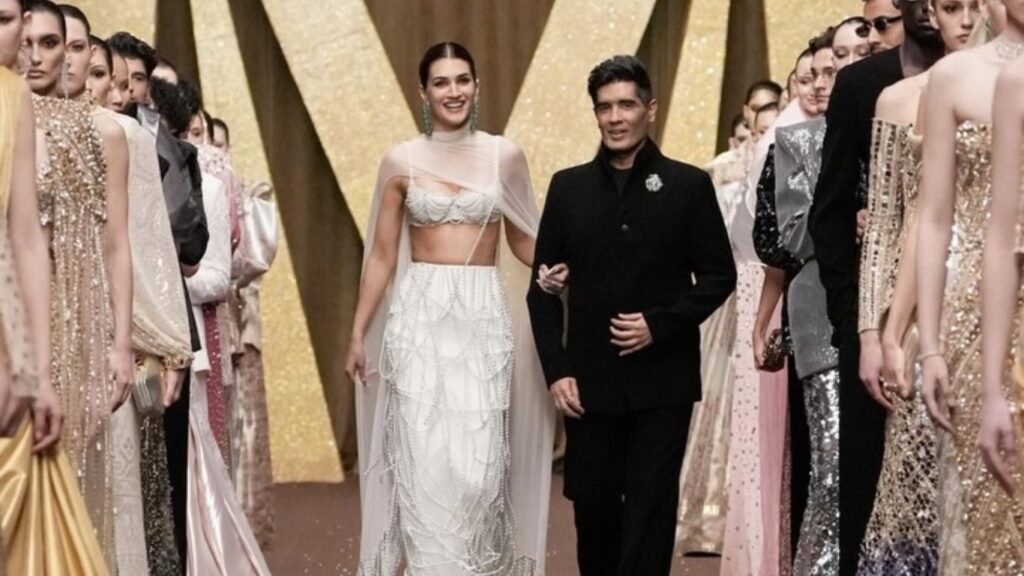
Dubai is increasingly becoming a global launchpad for South and Southeast Asian fashion brands, as designers look beyond traditional fashion capitals such as New York, London, Milan and Paris.
The trend was yet again clear at the latest Dubai Fashion Week (DFW), held the first week in February at the Dubai Design District. Many of this year’s brands on display came from India, Vietnam and Indonesia.
Those designers presented alongside regional and Western labels, including Italian fashion house Alberta Ferretti and British designer John Richmond, reflecting Dubai’s growing role as a bridge between Eastern and Western fashion markets.
Among the headline names was Indian couturier Manish Malhotra, who closed the week with a packed runway show attended by some of the city’s most influential fashion insiders. Malhotra, whose label is widely regarded as one of India’s leading luxury fashion houses and is popular among Bollywood’s biggest stars, said he chose Dubai over other fashion weeks because of its diverse audience, which understands craftsmanship, luxury, and elegance.
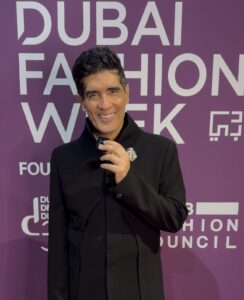
Manish Malhotra speaking with the Click after showcasing at Dubai Fashion Week
“For me as a designer, it’s very important that I take my culture on a global platform,” Malhotra said after the show. “Dubai as a city is an extremely welcoming, warm city of different cultures and different people, and for me, there can be no better platform or a better place to show a wide collection of various cultural work all put together,” he added.
Malhotra also described DFW as a place where “different worlds come together,” connecting South and Southeast Asian designers with international buyers and press – while offering a platform to showcase their cultural heritage on a global stage.
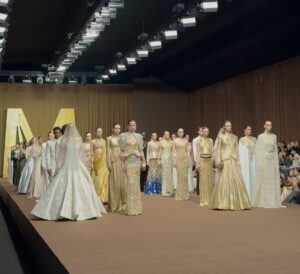
Manish Malhotra’s SS26 collection titled Inaya: The India Story at Dubai Fashion Week
His collection, Inaya: The India Story, was a masterclass of that ambition. Featuring embroidered abayas, tailored blazers, and saris reinterpreted through a contemporary lens, the collection showcased intricate craftsmanship from across different regions in India.
The runway reached its finale with Bollywood actress Kriti Sanon, who closed the runway in a pristine white, pearl-embellished ensemble.
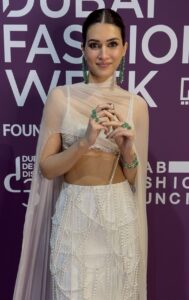
Bollywood star Kriti Sanon closed Manish Malhotra’s fashion show wearing custom pearl ensemble
“I loved my outfit. I felt like I was gliding with pearls,” Sanon said. “It had the Indian elements but a very modern take on it,” she noted, highlighting how Dubai’s fashion scene has become a natural stage for modern South Asian couture.
Beyond the glamour of the front row, which included guests from Bollywood actor Taha Shah Badussha to Dubai Bling personality Farhana Bodi.
Irish designer Tara Ott, founder of the label OTTÉ, said her brand saw unexpected demand after showcasing her collection at DFW in September last year.
“We’ve gotten a lot of attention. Actually, my dresses went viral, which I didn’t expect,” she said. “We ran out of stock and couldn’t meet the demand, so I learned a lot along the way. We’ve also had some amazing collaborations with some A-listers,” Ott added.
While she describes the UAE fashion market as competitive, Ott said Dubai’s relatively young fashion scene makes it easier for international designers to gain exposure compared with more established fashion capitals.
“Dubai is really up and coming in terms of fashion and innovation,” she said. “There’s such a mixture here. It can be quite modest, but it can also be quite fun, which makes it a diverse market for brands to showcase and express their creativity.”
This commercial appeal is backed by data. According to luxury retailer Chalhoub Group, fashion was the largest luxury category in the Gulf Cooperation Council (GCC) between 2024 and 2025, valued at $5.2 billion. In the UAE specifically, fashion is projected to grow by about 5% annually through 2030, according to Euromonitor International—a rate that outpaces many traditional global markets.
To support these commercial outcomes, Dubai Design District (d3) and the Arab Fashion Council (AFC), organizers of DFW, have expanded the event’s Buyers Programm. This season hosted a roster of international retailers, including global platforms such as Revolve, alongside department stores and concept retailers from Europe and Asia. The initiative focuses on brand discovery and B2B matchmaking, creating room for designers to translate runway exposure into business deals – something that can be far more difficult to navigate in saturated markets of older fashion capitals.
While London, Paris and New York may still set the tone for global fashion, Dubai Fashion Week reflects a city determined to carve out its own path in the global fashion ecosystem. Launched only in 2023, it remains young but has quickly gained stature on the fashion calendar. For many fashion brands looking to leap from regional recognition onto the global stage, that runway now increasingly runs through the Emirates.
Related Posts
December 8, 2025
Filling the Void: Gen Z and the Myth of Beauty
“They send me pictures of their faces with a filter that alters their features and say, ‘I want to look like this.'”
October 27, 2025
Author Antoine Gregory on Preserving the Legacy of André Leon Talley
“I wanted people to understand that clothing lives too," the author says.