May 27, 2026
Categories
Government, Immigration, Journalism, Law & Justice, News & Politics
Tags
Share
SEATTLE, Wash. — In Minneapolis, a tear gas canister rolled under Shawn and Destiny Jackson’s car. The couple and their six children were trapped as the chemical irritant engulfed them.
The family was coming back from a basketball game in early January when they found themselves in the middle of a confrontation between protestors and Immigration and Customs Enforcement (ICE) agents, according to reporting done by The New York Times.
The youngest child was just 6 months old and required resuscitation efforts due to the effects of the tear gas. The 6-month-old and two additional children were brought, along with their parents, to a hospital for additional medical care.
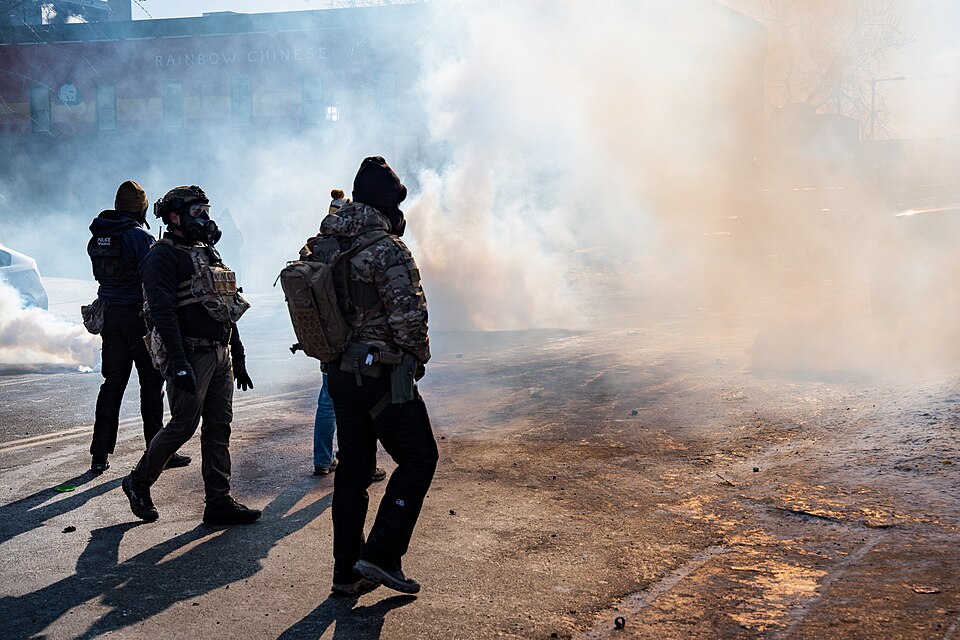
In cities across the country, law enforcement agents are using the chemical agent tear gas in efforts to rein in protestors. There is no federal oversight of the manufacturing of tear gas leaving tear gas manufacturers and law enforcement to self-regulate. There are reported physical effects after exposure and the chemical irritant has been largely understudied in regard to long-term effects.
Despite being a riot-control agent used by local, state and federal agencies, the Department of Health and Human Services does not regulate the manufacturing of this chemical irritant. Congressional lawmakers have said they are concerned about the effects tear gas has on those exposed to its fumes, according to a memo by Congressional lawmakers.
“In the absence of federal guidance, manufacturers and law enforcement have free rein to self-regulate,” the Congressional lawmakers wrote in a 2021 memo on the risks associated with the lack of federal regulation on tear gas; noting that the federal government has not conducted epidemiological research to determine whether it is safe to use.
The Congressional lawmakers also noted that self-regulation leaves room for uneven standards as each jurisdiction sets their own standards for regulation. And manufacturers for the most part, according to the memo, “defer to law enforcement ‘philosophies’ on how to use tear gas.”
Within this oversight gap, a parallel gap in researching the effects of tear gas was documented.
The foundational research that has been conducted was mostly done in the 1950’s- ‘70’s, on healthy military men, according to a study by the National Research Council Assembly of Life Sciences. This study observed the health status of men who were exposed to tear gas for the sake of understanding the short and long-term effects. The findings were insufficient for a full assessment.
A study conducted by the National Advisory Committee which evaluates tear gas guideline levels analyzed limited data on the effects of tear gas on pregnant women.
However, the effects for women, children and elderly remain significantly understudied.
The Congressional lawmakers had sent letters back in 2021 to tear gas manufacturers, the U.S. Department of Health and Human Services, and the U.S. Environmental Protection Agency inquiring about the safety of these products. The lawmakers didn’t respond to a request for comment.
When Tear Gas Hits the Press
A yellow plume erupts as clicks and explosions echo amongst the Seattle streets. People in face masks, with beanies and hoods, walk away from the tear gas wiping their eyes and coughing.
Nathalie Graham, a columnist for the Seattle newspaper, The Stranger, was covering the May 30, 2020, Black Lives Matter protest when she claimed that police dispersed tear gas without any warning.
“She had to stop reporting on the scene because she feared for her safety — not because of the protesters, but because of the police tactics being deployed against the protesters,” according to a complaint filed against the City of Seattle for the police brutality against peaceful protestors.
Graham described being surrounded by flash-bang grenades and tear gas. She then explained being fearful that the use of less-lethal weapons would only increase.
An incident occurring just days later on June 2 “forced her to retreat to The Stranger’s office and close the windows” due to “the sheer amount of gas that the SPD [Seattle Police Department] deployed against the peaceful protesters,” the report said.
She described her inability to see the road from her office as the street was immersed in gas. The tear gas eventually seeped into her office causing her to cough.
“Even when the windows were closed,” she told The Click. “My eyes were stinging, my throat was burning, and I was still trying to record.”
Clinging to her phone, Graham continued to live stream as she was left with no other choice but to wait out the attack.
“The air was spicy,” she said, as she explained the way her body reacted to the irritant. “I don’t know what the long-term effects are. Especially for those protesters who were out there for hours on end and who stood in those tear gas clouds way more than I ever did.”
Graham was unaware of the lack of federal regulation on tear gas. But she wasn’t surprised.
Her experience with tear gas during those two protests she was reporting on led her to sue the City of Seattle.
Six individuals, including Graham, and the Black Lives Matter Seattle-King County group, filed a complaint June 2020 against the City of Seattle for less lethal weapon and chemical irritant use. On account of ongoing protests, a 30-day temporary ban on the use of tear gas was issued by the Seattle City Council.
Part of the reason she decided to sue, written near the bottom of her legal declaration, was the impediment on her First Amendment rights as a citizen and as a journalist.
“I decided that reporting on the situation was no longer worth the pain of enduring tear gas and the risk of suffering violence at the hands of law enforcement,” it read.
History of Tear Gas
Tear gas was introduced to the United States in 1917. Created by German Scientists and used during World War I, the chemical irritant was used on opponents in warfare, according to the Science History Institute.
A few years later when race riots and protests erupted in the United States, “law enforcement clamored for a crowd-control tool that did not involve shooting civilians,” the Science History Institute’s magazine said.
As soldiers returned home, needing jobs, veterans realized that tear gas could solve two problems: “Its use could safely disperse rioters — without the use of violence — and its continued production might create more jobs,” the magazine said.
So, tear gas was introduced to law enforcement and became legal domestically.
However, in 1993, the Chemical Weapons Convention opened for signature, effectively banning tear gas from war in 1997, according to the Chemical Weapons Convention (CWC). This was in compliance with the Geneva Protocol of 1925 which prohibited the use of chemical and biological weapons in warfare. The United States continues domestic use of tear gas via the agreement. The standards allow tear gas to be used as a riot control agent.
Philipp C. Bleek, a Middlebury professor and expert in chemical weapons and nonproliferation efforts, explained that unlike the unambiguous nature of the agreement for domestic use, “whether military occupation counts as law enforcement is left ambiguous.”
The differing language of the agreements has contributed to this uncertainty. According to the Arms Control Association (ACA), the CWC does not clearly define the difference between law enforcement and warfare, allowing states to adopt differing interpretations.
During the 2020 protests, tear gas was deployed in at least 98 U.S. cities, according to an investigation conducted by The New York Times. Tear gas use by law enforcement isn’t new, it’s just more widespread, according to Amnesty International, a human rights advocacy organization.
Amnesty International and other human rights groups note that it’s banned in warfare but deployed on civilians, who are often lacking protective gear and are made up of vulnerable populations.
According to the CDC, the physical effects of tear gas can be some or all of the following: blurred vision, burning of the eyes, runny nose, difficulty swallowing, coughing, shortness of breath, skin rash, nausea, vomiting.
For citizens who already have certain health conditions, tear gas can exacerbate certain symptoms.
The CDC recommends immediately washing one’s eyes and body with water and throwing away clothes that have come in contact with the gas.
What Agencies Say (or Don’t Say)
Agencies determine what is safe on their own. Manufacturing companies know tear gas is dangerous, according to the Congressional lawmaker’s memo after reviewing training materials provided by three large suppliers: Safariland, Combined Systems, and Pacem.
The Click contacted manufacturing companies including large supplier Defense Technology also known as Safariland, to discuss their standards and guidelines, but none of the companies replied to interview requests.
However, in the Defense Technology safety data sheet, an acute effect of tear gas is listed as a “simple asphyxiant” which “may displace oxygen and cause rapid suffocation.” This can occur when the irritant is expelled in low-ventilated areas, according to the data sheet.
There are warnings on tear gas products informing that tear gas “can have serious effects on human health and that tear gas can remain in homes, on clothing, and even in food long after it is deployed,” according to the Subcommittee’s memo.
Various agencies conduct their own testing or lack thereof of tear gas bought from these large suppliers.
The Portland Public Bureau (PPB) told The Click about their process. The PPB has conducted unscientific testing of less lethal launchers and munitions observing various distances, angles, and situations. “But as far as scientific safety testing of the munitions and materials, that is not something we have done or have funding to do,” Sergeant Kevin Allen told us. “We have relied on the manufacturer for that information and testing.”
Although some agencies regulate with unscientific testing like the PPB, “some law enforcement associations have failed to implement strict standards for tear gas use” according to the Subcommittee’s memo.
However, since 2021, federal agencies have been increasing their training to adequately cover safe practices for using less lethal weapons, according to an article from the Council on Criminal Justice.
The Click also reached out to ICE for a statement and received no response at the point of publication.
Many law enforcement groups find commenting on this topic to be a double-edged sword, according to multiple anonymous Washington State law enforcement personnel. On one hand, tear gas is helpful when stopping violent protests without causing death. On the other hand, tear gas can be dangerous when used incorrectly.
As the ACA wrote, “when [tear gas is] utilized in accordance with manufacturers’ instructions and in line with international human rights law and standards, riot control agents can provide an important alternative to other applications of force more likely to result in injury or death.”
[UPDATE: June 10, 2026: Several paragraphs were edited to clarify some historic details.]
Related Posts

September 10, 2026
Simon and Fannie’s Story: A Tablecloth, a Family Mystery, and Me
I knew that my great-grandfather and his younger brother immigrated from Poland to the U.S. in 1922 when they were only 19 and 17. I did not know the tragic story of the family who were supposed to come with them until I found a photo behind a picture frame.

September 8, 2026
Who’s Really Running the Water in New Jersey’s Capital City?
Interviews with residents and city leaders, a review of government meetings, and governmental standstills show how few officials have been willing to take accountability for the urgent rehabilitation of the Trenton Water Works.