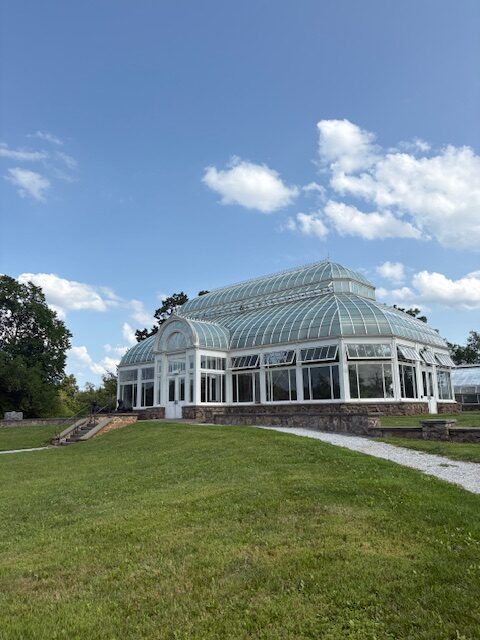
Linda Johnson is braving the sweltering heat of July to prune orchids in a massive, swampy greenhouse. She assesses each bloom with a delicate hand, turning them to the side and parsing through the leaves.
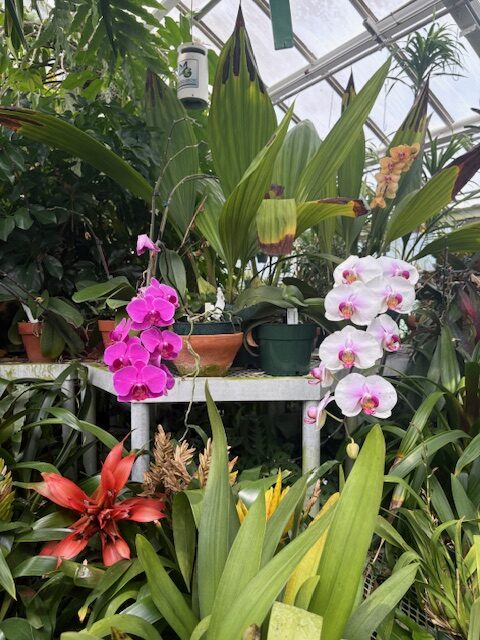
The orchid range at Duke Farms sits inside a massive greenhouse, which is open to the public. [Credit: Lara Becker]
She peruses some of the the approximately 1,300 different orchid varieties like Cattlianthe Barbara, a historic primary orchid; and Phragmipedium Mont Fallu, a hybrid “lady slipper” orchid.
“Welcome to the rainforest,” a visitor calls as he pulls open the greenhouse doors to reveal succulents, pines, palmettos, moss, and greenery draped from high ceilings, throughout its many wings.
Johnson is a volunteer at Duke Farms, a 2,700-acre nature preserve in Hillsborough, New Jersey. Every two weeks, for two hours, she helps maintain the grounds. After visiting just one time in 2024, she immediately fell in love with the place. She knew when she retired, two years later, that she wanted to come back and lend a hand.
“It’s like paradise in here,” Johnson said of the orchid range. “The flowers are wonderful. A lot of them just smell so lovely and it’s a great antidote to the stress in the world.”
Orchids were a favorite, or really an “obsession,” Johnson said, of Doris Duke, who is the founder and vision behind the Center for Conservation at Duke Farms. She was the daughter of American Tobacco Company founder James Buchanan Duke, who originally bought the property in 1893. It was passed on to Doris in 1925, who in her will, specifically requested that her properties in New Jersey, Hawaii, and Rhode Island be used for “educational and mission-advancing programs,” related to conservation.
There’s plenty to do beyond the greenhouse and the Orchid Range: a hay barn, sculpture garden, great meadow and zen garden are also spread throughout the vast grounds. It’s a privately-owned estate, but open to the public and free to enter from Tuesday through Saturday.
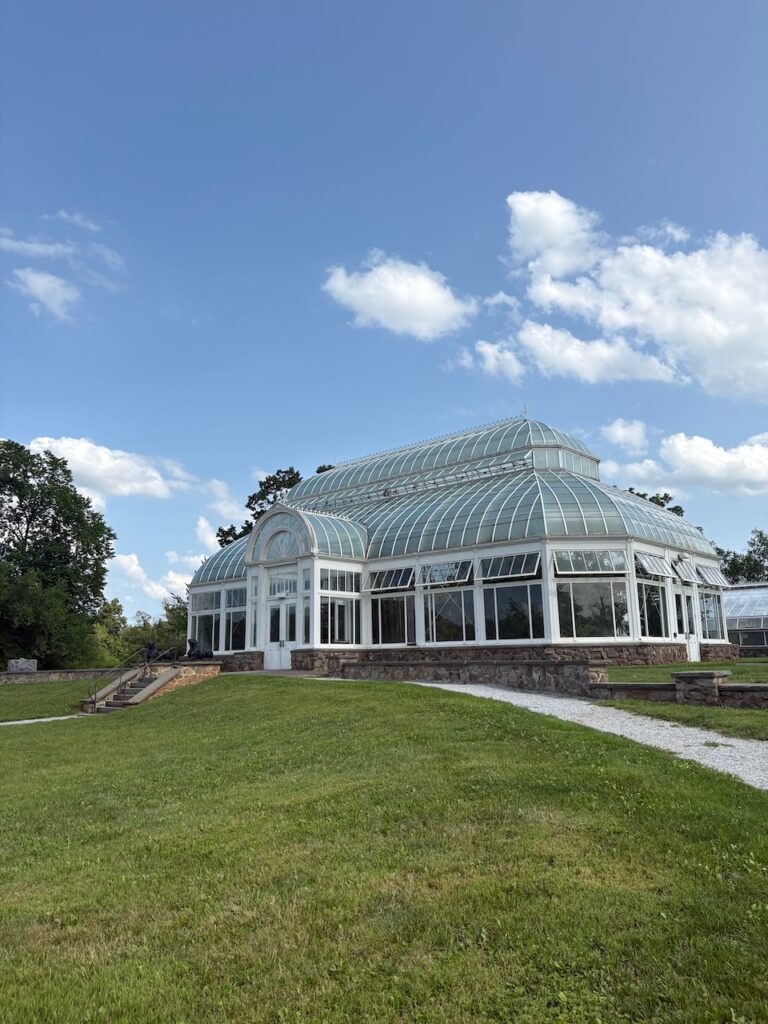
The greenhouse on site features hundreds of orchids, as well as palmettos, pines, mosses, and succulents. [Credit: Lara Becker]
Luda calls Duke’s a “pearl in the middle of the desert.”
“We’ve actually tried every single trail,” says Vladimir. “It’s a place you can just sit for hours.”
“Whatever your political stripe is, you gotta agree the world’s chaotic,” Johnson says. “It’s really stressful for people. Plants do an awful lot to help people relax and get centered. And to not go to bed really, really upset.”
But Duke’s mission goes beyond beauty and tranquility. They see themselves as environmental stewards. In a time where the federal government is making cuts to greenhouse gas regulations, habitat protections for endangered species, and reversing of safeguards to public lands, they want to show farmers a model for a more sustainable future.
Duke’s calls themselves a “living lab,” helping farmers developing conservational strategies under real operational conditions on the property.
Erin Treanore, scientist and manager of agroecology at Duke Farms, explains how the staff puts this into practice on a daily basis:
“Duke Farms’ location within a large, actively managed landscape enables researchers to move beyond small experimental studies and really ask questions under the testbed of real-world pressures, thereby functioning as a living laboratory,” she says. “Obviously, our research question varies by disciplines, and within agroecology; this means asking what it looks like to produce food sustainably within New Jersey.”
The concept of agroecology, a newer program at Duke’s that Treanore has been developing for the past year, means farming by working with nature and not against it, according to the Agroecology Coalition.
One example of this happens by optimizing rainwater. Herbaceous and woody plants are placed in the parking lot to soak up the water runoff, where pollutants are left by vehicles. Not only do the plants prevent flooding on the blacktop, but they can actually act as a filter to remove the pollutants from the vehicles. This process is called a bioswale.
“A lot of it comes down to putting science into practice every day” said Treanore. “Across the property, our teams are actively managing and restoring habitats, monitoring wildlife and ecosystems, and using what we learn to continually adapt how we manage the landscape.”
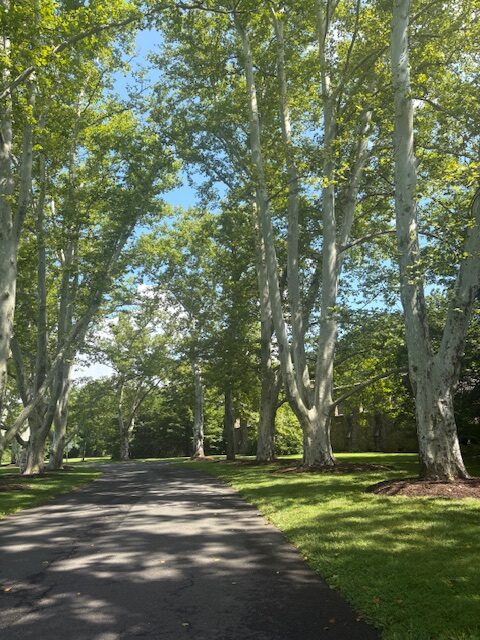
Visitors at Duke Farms have access to bikes, hiking trails, natural reservoirs, and plenty of native wildlife. [Credit: Lara Becker]
To further this mission, the farm does not only study and research conservational strategies. They also put an emphasis on teaching. Staff members at Duke’s often host guided walks with a focus on different species, like a nighttime moth walk and a discussion of invasive plants.
But beyond the conservation and wildlife restoration practices, what Duke’s sees on a daily basis is a hub for community.
Bikers, runners and hikers have their pick of dozens of scenic trails. Today, lots of bikers are out, zipping through the blacktop as the crickets buzz in towering trees above. Every visitor’s shirt is drenched in sweat from the burgeoning humidity of the summer. But they’re here, and here to stay, guests say.
Related Posts

February 20, 2026
Too Many Warehouses: Industrial Expansion Meets Community Resistance in a California Town
Perris residents are pushing back against the proliferation of warehouses as city leaders impose a 10‑month hiatus on new industrial development. "How is it possible that a park is boxed by shipping containers?" asked one resident.

January 2, 2026
Making The Neighborhood: The Future of Hudson Yards
Hudson Yards was once a maze of rail lines, a forgotten industrial area that few New Yorkers bothered to cross. Today, that same stretch gleams with glass towers, luxury shopping and an ambition to redefine urban living.