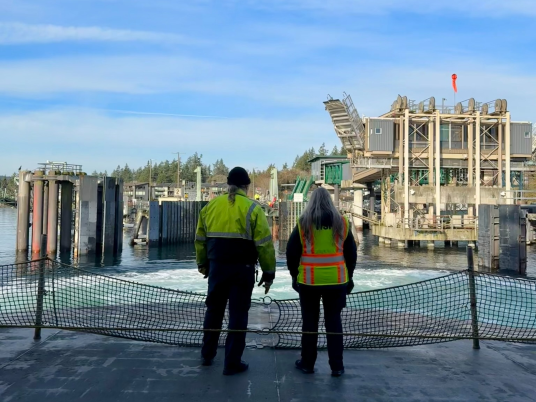
(SEATTLE) — At 8:45 in the morning a cormorant circles once over the Bainbridge run, hesitates in the wind coming off Elliott Bay, and settles on the mast of the ferry Tacoma #1 just as deckhands in neon yellow vests begin waving the first row of cars forward.
Passengers come aboard with the quiet decisiveness of people who have taken the same trip many times before. Most carry coffee cups. Some hold small suitcases or grocery bags. A few walk straight to the outside rail and stay there as though the crossing were longer than thirty-five minutes and required preparation.
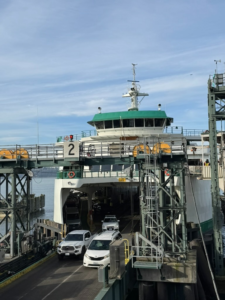
Cars departing from the Tacoma #1 into Seattle. [Credit: Emily Iris Dickinson]
In a narrow office midway along the passenger deck, Second Mate Zack Helsiano filled out a Coast Guard form concerning a large vehicle and spoke quickly into a handheld radio without looking at it. Beside his chair hung four firefighter turnout suits, prepped and waiting, their reflective stripes catching the fluorescent lights with subtle movement.
Every crew member is trained for emergencies — though Helsiano says most emergencies need only a Band-Aid.
“You can follow me,” he said.
An ordinary seafarer (OS) handed over a yellow safety vest before Helsiano headed down the metal stairs toward the car deck.
The ramp lowered with the help of two able-bodied seafarers (AB’s). Engines idled in a slow, staggered rhythm. Helsiano stood with the two seafarers and a trainee while the line of cars started moving toward Bainbridge Island.
As vehicles moved onto the ferry, Helsiano watched to make sure all went smoothly. Despite multiple announcements, some passengers were still missing from their cars. Others, who stayed in their vehicles listening to the radio, had run their batteries dead. That’s when Helsiano steps in with cables to jump their car. Sometimes, if the car won’t start, he has to push it off the ferry himself.
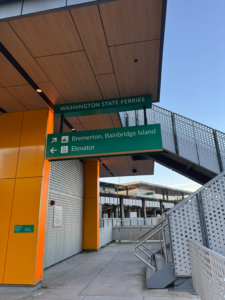
Signs direct passengers to the Washington State Ferries. [Credit: Emily Iris Dickinson]
“Oops, it just fell out!” he said.
The AB laughs, picks it up, and fiddles with it in his hands without interrupting traffic flow. He hands the snack to the trainee. No one else reacts.
After the final vehicle rolled down the ramp, Helsiano gave an all-clear on his radio and receives one back from OS Mike above. The return line of cars began boarding almost immediately. The pause between passengers occupying the ferry is the only short deviation from the constant motion.
He directed vehicles by size and weight so the boat would sit level in the water. Larger trucks forward. Smaller cars angle into the narrowing lanes near the sides.
At the start of each seven or nine-hour shift, he checks supplies: radios, extinguishers, life jackets,Band-Aids.
Most incidents are minor.
“I had someone jump off the boat right as we docked into Seattle,” he said. The person was intoxicated and immediately wanted back on board.
He signaled the next car forward as he speaks, never quite turning from the moving line.
Up in the pilothouse the air is quieter and brighter. The quartermaster stands at the wheel with binoculars in one hand while the captain faces the horizon, saying little. A radar rotates in steady green circles. Short bursts of radio conversation start and stop without explanation.
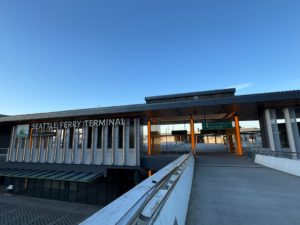
Every day, thousands of riders pass through Pier 52, Seattle Ferry Terminal. [Credit: Emily Iris Dickinson]
“Do you see that? What is that?” he asked.
Halfway between the ferry and the skyline, a dark shape floated on the surface. As the boat draws closer the shape resolved into a bloated sea lion, rocking slightly in the wake of passing traffic. No one altered course. The vessel passed as though the animal were a buoy whose purpose has been forgotten.
The crew navigates partly by instruments and partly by landmarks they have named themselves. The captain called for a small correction toward a building they called “Little Schmitty” and away from a cluster known as the “Three Sisters.” The wheel moved only a few degrees.
Below, passengers leaned along the rails watching the city approach. Others remained indoors scrolling on phones. Most did not notice the adjustment.
The captain took control for docking. Instructions traveled simultaneously to port managers and deckhands through different radios. The ferry swung left and eased into the terminal gently enough that conversations inside did not pause.
The ramp dropped. Deckhands tied the ferry to the dock. Vehicles left. Passengers followed. With efficiency, boarding began again in reverse order.
Helsiano remained on the car deck while the next set of cars arranged themselves into lines. Some drivers stepped out to stretch. Others stayed inside as if still on land.
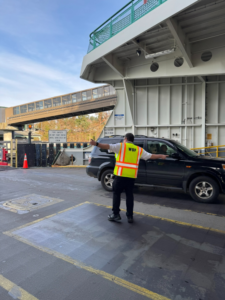
Helsiano directing cars off of Bainbridge Island onto the Tacoma #1. [Credit: Emily Iris Dickinson]
The horn sounded. Lines tightened. Propellers turned.
The boat separated from the dock almost imperceptibly until the water widened behind it and the Seattle skyline began shrinking.
The stern carved through the waves as the cormorant dropped from the mast to fly back toward the city, disappearing briefly into the wake and rising again as the Tacoma #1 turned toward open sound to repeat the crossing.
A woman, who appeared to be a regular as she sat down with ease on a green cushioned bench facing the city, opened a thick paperback book and slipped into the world on the page. Another woman led a small white dog on a leash along the inside corridor. It was the first week pets were allowed on board, a rule that seemed to bring her and her small companion joy. A teenage boy paced the outer deck, the wind whipping his brown hair into his eyes.
The loudspeaker sounded once, briefly, then again with a correction no one commented on. Coffee lids clicked open. A stroller rattled over a threshold and then stopped after the parent lifted it an inch.
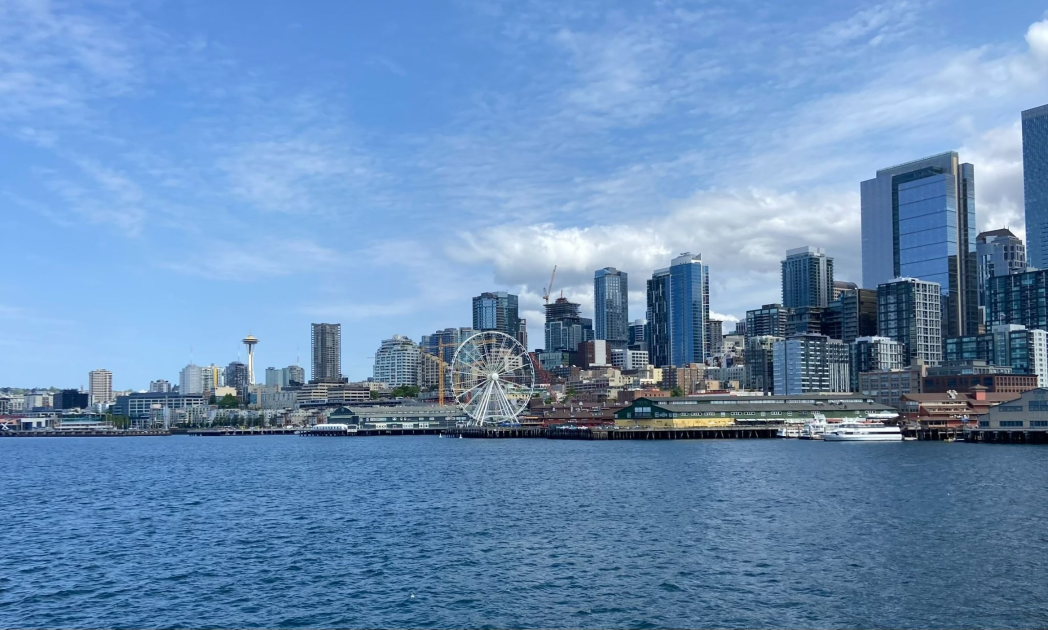
A sweeping view of the Seattle skyline is included in the ticket. [Credit: Emily Iris Dickinson]
Another ferry passed close enough for passengers to look directly into its windows. Though they could not see their counterparts, the Tacoma #1 passengers knew they were doing exactly the same things.
The tree line of Bainbridge Island drew nearer, though it did not seem to grow. Instead the water changed, flattening and darkening as the ferry entered the harbor.
The Tacoma #1 adjusted its angle by a degree or two and continued forward, moving into port and out again, back to Seattle.
Related Posts
October 9, 2026
Chef Arwa Lootah is Putting Emirati Cuisine on the Map
For hundreds of years, Emirati cuisine has rarely been documented or written down. Now, Emirati chef Arwa Lootah is reimagining the nation’s food for a new generation.
November 25, 2025
Between Doubt and Hope: Journalists Chart the Future in Challenging Times
At the 7th Annual Incubator for Media Education and Development Forum in Greece, journalists from around the world confronted the rising threats to press freedom while exploring how collaboration and AI innovation might redefine the future of reporting.