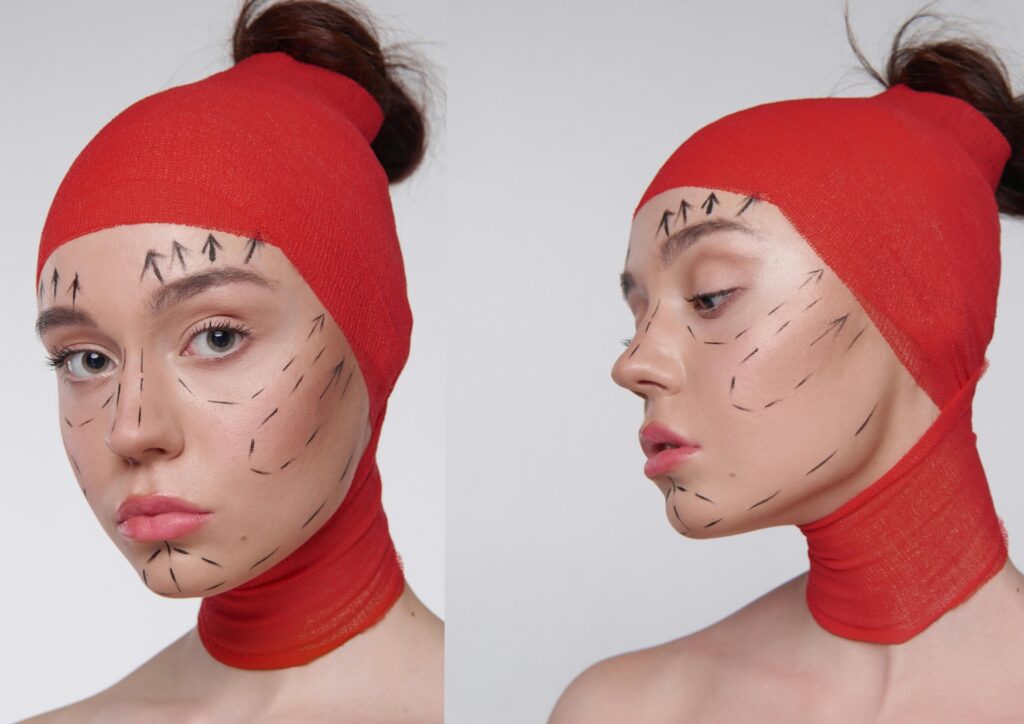
(GENOA, Italy) — Martina was 20 years old in 2023, when she entered a cosmetic practice to get a nose filler. The doctor welcomed her with a syringe in hand.
“I started breaking out in a cold sweat. I didn’t expect it,” Martina said. The procedure took around 10 minutes. “It felt like a butcher’s shop,” she recalled. Despite the discomfort, she returned one year later for a refill. “I liked the results,” she explained.
Plumped lips, upturned nose, pronounced cheekbones, fox eyes — almond-shaped with elevated outer corners — and well-defined jawline. This is the recipe for beauty and cosmetic doctors can offer all the ingredients. Martina, now 22, sees these perfect faces online and compares them with hers. What she doesn’t know is that these tweaks, which appear to be a confidence boost, often mask a deeper need for a sense of belonging and identity.
Martina is just one of many young women who are seeking expensive and possibly dangerous procedures. The web is crowded with doctors who constantly advertise cosmetic medicine and ‘beautification’ — the procedures needed to become a better version of yourself. The new face of beauty inspired by social media — the face which Gen Z and some Millennial women are lining up to get — is making the market grow fast.
For years, image-driven platforms like Instagram and TikTok have intensified pressure on young women to emulate the features of celebrities and influencers, from Bella Hadid to Kendall Jenner. Writer Jia Tolentino labeled this phenomenon “Instagram face.” Now, data shows that the situation is beyond the saturation point.
The cosmetic medicine industry
Nearly half of the patients seeking cosmetic procedures are between 19 and 34. A September study revealed that the European dermal filler market is experiencing growth, and Italy — with revenue expected to reach $746.5 million by 2030 — ranks fourth in the world for total procedures done in its nation. In 2024, according to ISAPS, 20.5 million nonsurgical procedures were performed worldwide and Italy accounted for 891,000 of them — including more than 430,000 hyaluronic acid injections, with lip filler being one of the most popular.
Genoa is a medium-sized city in northern Italy, better known for its aging population than for beauty trends. Recently, it has been witnessing a boom in cosmetic medicine. In a recent interview, Dr. Marco Enzani, a cosmetic specialist working in Genoa and La Spezia, pointed out that demand for cosmetic treatments in the region has risen sharply among people aged 25 to 35. According to Enzani, patients under 35 made up only 15% of the market in 2014, but by 2025 they accounted for 25%. Filler and Botox now represent half of the procedures done.
The trend is strong enough that the University of Genoa has introduced a master’s degree in cosmetic medicine, drawing doctors from across the region who want to specialize in injectables. Moreover, thanks to a law passed in 2023, named ‘Decreto Bollette’, even dentists can perform them.
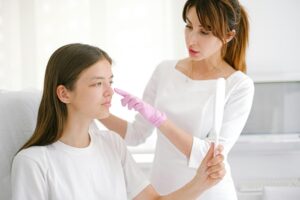
Younger people are now getting more invasive beauty procedures. [Credit: Anna Shvets, Pexels]
The psychological roots
A peer-reviewed study based on a cross-sectional survey, indexed on PubMed — an authoritative search engine for science literature — found that “those who used filters to edit pictures more frequently reported increased cosmetic procedure acceptance and intention.” In addition, a PRISMA-based systematic review indicated that “social media’s emphasis on visual aesthetics fosters body dissatisfaction and social appearance anxiety, especially through selfies.”
Some experts claim that who you follow on social media can predict your future chances of undergoing a cosmetic procedure.
Dr. Alina Cirillo, a psychiatrist in Genoa who works with young adults, describes two prominent feelings among this generation: the sense of shame and envy. “If they are all similar, they don’t need to feel shame anymore,” she said.
Dr. Antonio Costa, a psychotherapist of adolescents and young adults in Genoa, explained that young people find themselves in a kind of limbo — no longer the children they once were, yet not the adults they will become. “The body thus becomes a battleground,” he said, “the part of oneself over which one can still exert control.”
Although this observation applies to teens and not adults the impulses are similar as adolescence lasts longer. “I don’t notice a difference between some 16-year-olds and 26-year-old patients,” said Costa.
Patients’ voices
Body Dysmorphic Disorder is a psychiatric condition consisting of a preoccupation with flaws in physical appearance that cause clinically significant distress, such as social anxiety and avoidance. The disease is associated with higher likelihood of seeking consultations with plastic surgeons and cosmetic doctors.
The prevalence in the general population is 17%. The disorder is common, especially among adolescent girls. The face is the most visible part of our bodies, and it can easily become a playground for tweaks.
“Fillers are becoming a kind of status symbol,” said Dr. Eleonora Magda Seghi, a cosmetic doctor in Genoa, explaining how younger patients often seek dramatic transformations rather than subtle improvements.
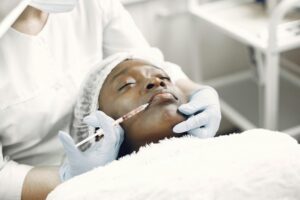
A patient gets aritificial fillers as part of a trending beauty service. [Credit: Gustavo Fring, Pexels]
The temptation of beauty is hard to resist. Reddit’s cosmetic-surgery channel draws almost 33,000 visitors per week, and it is filled with people seeking advice on whether they should undergo cosmetic procedures.
Young women are also sharing their experiences and their expectations on social media, sometimes encouraging their followers to do the same.
Gabrielle Dubois Meloff, a YouTuber, said she got chin filler with the “goal” to look like Hailey Bieber. “Her chin and jawline are just sharp and gorgeous,” she said in a video.
Breanne, a TikToker, admitted in a clip:“I have lip filler, and if you want it, you should get it. My life changed.”
Others on social media express regret about their decisions to get filler or Botox and are trying to warn people not to fall down the rabbit hole.
Jasmine Homden, another YouTuber, made a video about her regret getting chin filler. “I feel like we’re all our biggest critics,” she said, “and we all look at ourselves and wonder what it would be like if this was different, would I be more attractive if this was different?”
Gabbie from The Gabbie Show with over 5 million subscribers on YouTube, said, “I saw the lack of self-esteem and self-love that got me to that point. I’ve done so much damage by promoting these dumb procedures.” She started by wanting to remove a mole, and ended up doing everything from lip filler to neck liposuction.
Martina said she didn’t experience a real self-confidence boost but has become more comfortable taking selfies. “I have to say that, for example, before I had problems taking pictures; now I don’t. But apart from that, [my self-esteem] is the same,” she said.
A global trend
The trend cannot be confined to Italy — nor to Europe. Everyone has access to the internet, social media, filters, and trends. Most every woman in her 20s faces identity issues, the so-called quarter-life crisis.
According to Dr. Debra Jaliman, a dermatologist and cosmetic doctor in New York, in her city, women are looking for the same kind of stereotyped faces. “They send me pictures of their faces with a filter that alters their features and say, ‘I want to look like this’,” she said.
Australia is one of the few nations to take measures to clamp down on the overuse of cosmetic procedures. The new rule, applied this September,, requires doctors to screen for psychological illness before proceeding with any procedures. Dr. Toni D. Pikoos and Dr. Ben G. Buchanan, two Australian clinical psychologists, founders of ReadyMind, designed a specific questionnaire — now used by 150 practices.
Pikoos explained that the questionnaire looks for psychological distress, body dysmorphia, perfectionism and self-criticism, and unrealistic expectations. When asked which patients most often flag positive for one of those problems, she replied, “Younger women. They are quite vulnerable to unrealistic expectations.”
To say “no”
That ambivalence resonates with some cosmetic doctors who are responding to these trends with concerns and are starting to say “no” to their patients.
Dr. Gavin Chan, a cosmetic doctor in Melbourne, decided not to do lip fillers anymore. There are two main reasons behind his choice: addiction and the longevity of filler. “People always thought it lasts months, but in 2019, I started doing some MRIs with a colleague, Dr. Master, and he published a study about the longevity of filler lasting 10 to 12 years,” he explained, noting that filler not only accumulates, but also spreads.
“I’m known as the ‘Doctor No’,” Dr. Tiziana Lazzari, a dermatologist and cosmetic doctor in Genoa, said, “but I think it’s sometimes better to satisfy a young patient’s wish with minimal treatments, rather than let her go to someone who tends to overdo things.”
Dr. Lidia Molinari, a cosmetic doctor in Genoa, shares these worries. “It becomes spasmodic research for a stereotype,” she said, “Patients seem to look for a homologous face.”
Dr. Erica Ponte, an Italian plastic surgeon, expressed concern about the growing number of practitioners who are not fully qualified.
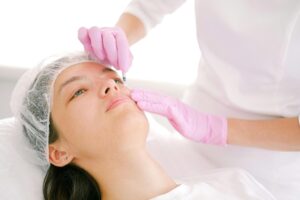
Cheek fillers are becoming a popular beauty procedure. [Credit: Anna Shvets, Pexels]
According to Chan, when patients decide to have their filler removed, they often regret the decision. “It is a new set point in their minds. Once you get used to that look, you’re stuck there,” he explained.
Trends shift but never really disappear. The focus has now moved to buccal fat removal — a procedure that removes the Bichat fat pad, a mass of fat in the cheeks, to create a slimmer face — which is projected to reach a US market value of $51.26 million by 2030.
Martina has recently read articles about the risks associated with filler. But when asked if this new awareness would stop her from doing another refill, it took a while for her to reply.
“Actually, I don’t know,” she said, “if I saw that my nose came back as it was before, I would be tempted.”
Related Posts

February 20, 2026
Too Many Warehouses: Industrial Expansion Meets Community Resistance in a California Town
Perris residents are pushing back against the proliferation of warehouses as city leaders impose a 10‑month hiatus on new industrial development. "How is it possible that a park is boxed by shipping containers?" asked one resident.

February 2, 2026
At 31, She Had a Heart Attack. A Decade Later, She’s Redefining Her Story
Ten years ago, Kisha Stewart was just 31 when she suddenly collapsed with crushing chest pain — what she thought was postpartum fatigue turned out to be a heart attack caused by Spontaneous Coronary Artery Dissection.