DALLAS, Texas – Hugs Cafe’s newly hired employees gather around a prep table to help measure ingredients to make brownies made from scratch. Some exchange cheerful banter amongst each other, while others observe the chef trainer in a comfortable silence. Staff, volunteers, and trainers came together, mixing batter and sharing experiences, as they prepared for opening day.
Hugs Cafe is a restaurant that employs adults with intellectual and developmental disabilities (IDD), and the cafe staff are preparing for the launch of its new location on Dec. 8. To train its newest cohort of employees, the cafe is using the training kitchen at the Dallas College Culinary, Pastry and Hospitality Center, which provides hands-on experience for aspiring hospitality professionals and hosts the training programs of Hugs Cafe, Inc. Ahead of the company’s second location’s opening, a three-week training program was held to introduce the employees to the culinary and hospitality industry.
While training in a workplace is nothing out of the ordinary, the acceptance of individuals with neurodivergence in work environments remains the exception rather than the norm. Despite the robust growth of Dallas’s economy in recent years, job opportunities for adults with disabilities have not kept pace. As Dallas’s economy continues to leave adults with IDD behind, Hugs Cafe Inc. — a nonprofit social enterprise headquartered in McKinney — offers an alternative: paid, long-term employment and industry training for a population that faces some of the highest unemployment rates in Texas.
Katie Sullivan, one of the new hires at the new location near downtown Dallas, said she plans to put most of her wages earned in the bank.
“I got my first pay check!” Sullivan, 49, said with pride. The rest of her check will be set aside to take her friend out for a birthday celebration.
Founded by Ruth Thompson, Hugs Cafe’s business model is effective, but not the only way workplaces can adapt to include neurodivergent employees. With demand for jobs far exceeding available positions, and Texas ranking among the lowest states for supporting independent living for adults with IDD, the breakfast and lunch-only restaurant expanding to Dallas demonstrates that meaningful, sustainable employment is possible.
The employment-to-population ratio, which measures the working-age population starting at 16, was 22.9% for people with disabilities in August compared to 65% for people without a disability, according to the U.S. Bureau of Labor Statistics (BLS) jobs report. These figures have been relatively stable year over year at 21.9% and 65.5%, respectively.
Likewise in August, the unemployment rate for people with a disability was 8.3%, according to the BLS, which defines disability broadly to include physical, sensory, and cognitive impairments — not just IDD. Adults with IDD face far higher unemployment, at roughly 17% in 2024, compared with 4.3% for adults without disabilities.
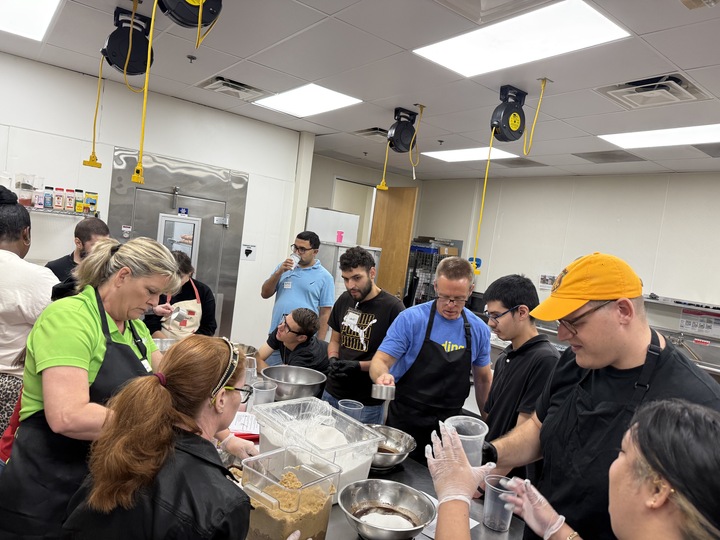
Newly hired Hugs Cafe employees gathered around prep table making brownies. (Photo taken by Diana Kay Manley)
The gap has remained persistent nationally, and is amplified in Texas, according to a 2019 report by Case for Inclusion, an annual report that analyzes data to evaluate how the U.S. serves the IDD community. Texas was ranked second to last place in terms of helping individuals with IDD lead more independent and productive lives. This trend has been consistent as Texas hasn’t shifted from the 49th or 50th spot since the report began publishing in 2007.
Hugs Cafe Inc. is attempting to address the higher unemployment rates among adults with IDD by offering networking and training opportunities in North Texas.
The first Hugs Cafe opened 10 years ago in McKinney, Texas, a suburb in the Dallas-Fort Worth metroplex. Thompson, the founder, initially opened the cafe with a dream: empower individuals by training workers in food service, then help them find employment elsewhere utilizing their acquired hospitality skillset.
But she soon realized many wanted to stay at Hugs Cafe. Thus, the business model evolved to employ colleagues for the long-term rather than using the cafe as a vehicle for short-term training and job readiness. With this shift, she chose to grow the larger organization through different programs.
In addition to the Hugs Cafe Inc., operates other verticals under the same mission: hiring and offering workplace training to adults with IDD. Those initiatives include: Hugs Greenhouse, which offers work opportunities in the agriculture and landscaping industry; Hugs Training Academy, a 12-week culinary and hospitality course; and Hugs Home Cooking, which provides monthly cooking skills classes.
In 2024, the Hugs Cafe and Hugs Greenhouse paid out $146,890 to 54 employees in 2024 for just over 18,500 hours of work. Of these employees, no one is full time and all are part time, with varying hours. One employee might work once a month while someone else may work a couple times a week. Like Sullivan, these wages often serve as supplemental income for professionals, many of whom rely on government assistance, support from their families, or both.
“The cafe and greenhouse are roughly 90% self-sustaining,” said Wendy Semper, who represents the administration of Hugs Cafe Inc. The coverage of most operational costs is noteworthy, especially in the restaurant industry. Other costs, such as administration costs, are funded by donations.
While the Hugs Cafe and Hugs Greenhouse employees are part-time, demand for employment remains outsized. “We have had a waitlist for McKinney. And those folks have over the years. We have had employees that have been there since the beginning,” Semper said.
“It is beautiful work [the employees] do, and the food they’ve prepared is all very good,” she said. “We make our own chicken salad. We don’t just buy stuff and pack packages and slap it all together. It is all made from scratch.”

A branded wall outside of Hugs Training Academy classroom. (Photo taken by Diana Kay Manley)
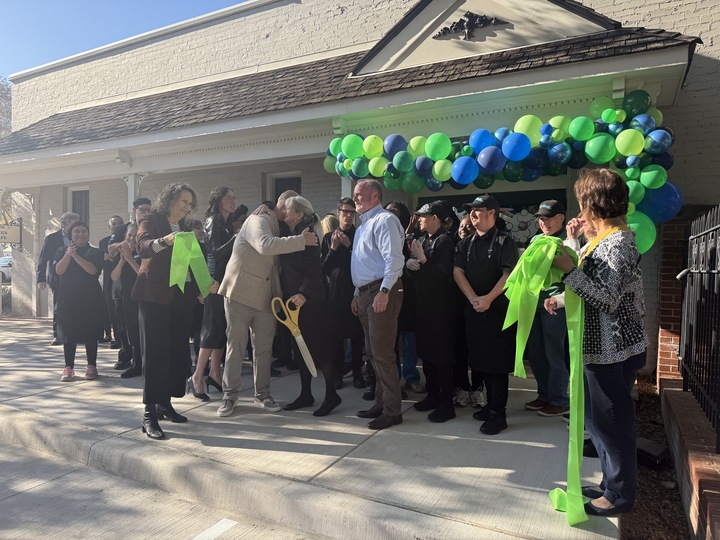
With the second location opening within Dallas city limits, Semper is hopeful the new location will serve as a destination that people look forward to visiting and eager to share with their friends. Similar to the flagship McKinney location, the Dallas shop has nearly reached its staffing goal of 40 new hires — before officially opening its doors and due to the high demand for employment.
Hugs Cafe isn’t the only company with a similar shared mission to employ more individuals with IDD. Other examples include Dallas-based Chance’s Cafe; Howdy Homemade Ice Cream which has locations across Texas, Louisiana, Colorado, Indiana, and Missouri; and Spectrum Designs in New York. These businesses offer sheltered workplaces, or employment in which employees with IDD work primarily in segregated settings. These solutions can foster a sense of belonging and a purpose, but generally consist of lower wages and may further separate employees from the broader community.
While these mission-based companies have enriched the lives of many on a local level, other nationally-scaled large companies incorporate neurodiverse hiring as part of broader inclusion efforts. As opposed to segregated workplaces, integrated employment consists of employees of all neurological backgrounds working alongside one another. The 2022 report by Case for Inclusion indicates inclusive employment can lead to greater awareness and acceptance outside the IDD community, but sometimes require additional education and resources by employers to set up employees for success.
Some established businesses with a significant presence in Dallas — such as Ernst & Young, Home Depot, and Kroger — explicitly provide inclusive hiring efforts for neurodivergent candidates.
Brock Elkins, 27, who once worked for a large company but chose not to identify it, faced hurdles typical of many mainstream workplaces. After voicing concerns about fairness, he found the environment did not provide the accommodations needed to succeed. Finding a workplace that recognizes his strengths and provides meaningful support has been pivotal for Elkins.
“I’m very confident in my coworkers and myself. I know we are going to be great,” he said.
Closing the employment gap in Texas doesn’t exist solely in segregated workplaces.
“We want [the IDD community] to be working,” Semper said. “Because … they just want to be able to do their job.”
Related Posts

February 20, 2026
Too Many Warehouses: Industrial Expansion Meets Community Resistance in a California Town
Perris residents are pushing back against the proliferation of warehouses as city leaders impose a 10‑month hiatus on new industrial development. "How is it possible that a park is boxed by shipping containers?" asked one resident.

January 2, 2026
The Truth Behind the ‘Misunderstood’ Athlete: Allen Iverson
NBA superstar, father, businessman, Hall of Famer, and now, an author; Allen Iverson details triumphs and setbacks in new memoir Misunderstood.