(TRENTON, N.J.) — “It has become clear that under the status quo, Trenton Water Works (TWW) can not maintain consistent compliance with state and federal safe drinking water requirements and, moreover, that the system will remain on the brink of catastrophic failure.” This is what the New Jersey commissioner of the Department of Environmental Protection wrote in a six-page open letter about Trenton’s water utility this July.
Commissioner Shawn LaTourette addressed Trenton Mayor Reed Gusciora and the Trenton City Council in the letter, stating that based on his observations that “TWW is plagued by historic neglect, decades of underinvestment, and operational risks.” He said that current operations “present significant ongoing risks to the health and safety of TWW customers.”
When it comes to water in Mercer County, it seems that everyone from residents, city leaders, and state representatives know how they’d want to fix the problems — if only they could agree.
“Even our dogs are not given tap water,” said Ewing resident Katelyn Dauphinee, who’s lived in the area for nine years. “To keep us as safe as possible, we’ve added a whole house filter, a reverse osmosis system, and use a Brita for all drinking, cooking, [and] washing water.” In speaking to residents from several jurisdictions serviced by TWW, it’s clear that Dauphinee is not alone.
But the sentiment is not shared by TWW spokesperson Michael Walker. Walker, the TWW Community Relations representative and Chief of Communications, also lives in the service area, but he told The Click that he doesn’t feel the need to use water filters in his home.
What does he think of the water supply? “I am very proud of our drinking water products because I know how it’s produced, and I believe it’s one of the finest in the world,” Walker told The Click.
Of LaTourette’s comments, he said, “We certainly do respect the commissioner personally, and we respect him professionally, and we respect his opinion, even those opinions that we disagree with.”
LaTourette declined to comment for this article.
![A central pump inside of Trenton Water Works [Credit: NJ DEP]](https://theclick.news/wp-content/uploads/2025/12/TWW_pump.jpg "RUSTY CENTRAL PUMP")
How did we get here?
Trenton Water Works feeds the city of Trenton, as well as parts of surrounding suburbs in Ewing, Hamilton, Lawrence, and Hopewell in Mercer County, N.J. It serves approximately 225,000 people — and is over 200 years old. The capital city’s slogan “Trenton Makes, The World Takes” was once a nod to the industrial benefits the world reaped from its role as a major steel, iron, and pottery producer. But now, it seems more like an unsettling omen than a triumph of industry.
Recent history tells us that water issues can divide and devastate communities. In 2014, corroded pipes in Flint, Mich., allowed lead and other pollutants to contaminate the water supply, exacerbating existing economic inequality. And in 2022, water treatment failures in Jackson, Miss., created disaster after years of neglecting the water infrastructure.
Trenton and Mercer County’s divisive issues seem to be no different.
“I almost compare this to Flint, Michigan, as a sarcastic joke, but sadly the tap water is so bad it’s not even drinkable,” Ewing resident Dustin Dow told The Click.
A series of troubling failures
At Trenton Water Works, the call is coming from inside the house — the problems are lying dormant inside the aging plant itself.
From 2021 to 2023, an outbreak of Legionnaires’ disease contaminated the Trenton Water Works supply, leading to three deaths in the area. After failing to contain the spread amidst other concerns, the DEP issued TWW a Unilateral Administrative Order in 2022, mandating that DEP representatives and a third-party oversight contractor inspect and evaluate the plant weekly.
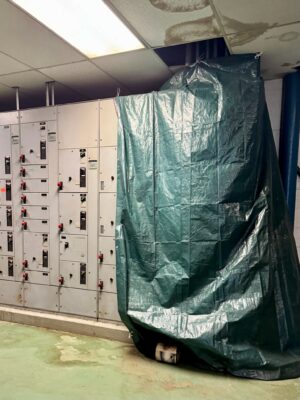
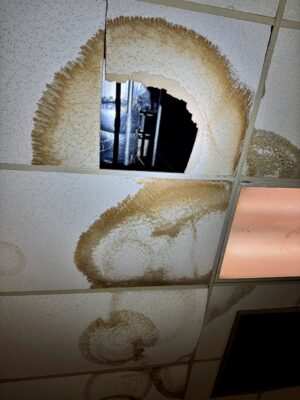
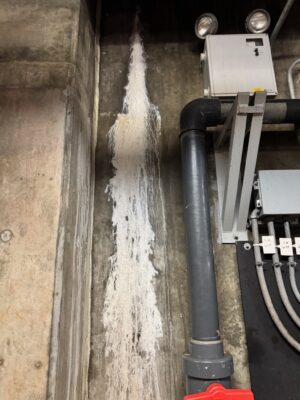
What they’d find was mold growing in the ceiling tiles, holes in the roof, and electrical cords draped through puddles of water, commissioner LaTourette reported to NJ Spotlight News, as seen in this report from August:
This was only scratching the surface. The DEP website breaks down the structural deterioration of the plant into four main “points of failure:” ongoing roof leaks, issues with filtration plant intake, corrosion of electrical panels, and an aging and corroded central pump. The DEP notes that if this pump fails, water from the reservoir cannot be used. TWW is currently in the process of acquiring a new pump, but each takes two years to build.
But, these problems were known years ago. In 2019, TWW adopted a six-year capital improvement plan with intentions to upgrade the filtration system, remove existing lead service lines, and increase operational efficiency. However, Trenton City Council Vice President Jasi Mikae Edwards told The Click that when it comes to the capital improvement plan, TWW “has barely chipped away at it.”
Why? Edwards says it’s not only the building to blame — TWW is no stranger to personnel issues, too.
During the exact period of the Legionella outbreak, water tester and Trenton resident Cesar Lugo was discovered to have falsified a multitude of water quality tests, causing 2,172 water samples to be thrown out because their accuracy could not be verified. According to documentation released by NJ DEP, in a 13-month period from October 2022 through December 2023, instead of collecting samples from the field, the tester was submitting tests he took in his own home.
Lugo was indicted on multiple criminal charges in May of 2025 and awaits final sentencing. TWW was fined $235,000 for taking so long to detect the fraud and for violating the New Jersey Safe Drinking Water Act.
And there’s evidence that personnel issues go beyond this one happenstance. A January 2025 Technical, Managerial and Financial (TMF) report found that there are insufficient staff members to fill all roles at the utility, which has led to over-worked operators and lapses in training.
“There’s complacency, there’s legitimate incompetency due to the lack of training, and there is deliberate incompetency, because I believe there are some people [who] know what they’re doing and just deliberately not doing their job,” Edwards said.
In response to staffing concerns, Walker told The Click: “At the end of the day, Trenton Water Works infrastructure is very well engineered, and it’s run by very, very capable, very, very talented people.”
“It has been a nightmare for years,” residents say
“Every morning, without fail, I see the same nasty tint in the water that I’ve seen for at least half a decade now,” resident Dow said. “Even if I cook with it, I notice my stomach will feel funky, so I try now not to even cook with the water.” Dow said he bought a ZeroWater filter that comes with a water tester, and when he tested his tap water, the results landed in the range of “high hardness.”
“It has been a nightmare for years,” said Ewing resident Steven Remboske. “People depend on the TWW to provide safe drinking water but because of corruption, incompetence, ignorance and bad hiring practices [it] doesn’t do any justice for safe drinking water.”
Ewing resident Jennifer Johnson-Roth said that in 2023, a TWW member came to flush out the fire hydrant in front of her house, and, “He broke the hydrant and my water line in the process. He left and I had no water,” she told The Click. When the worker came back to fix the fire hydrant after the water had been repaired, they broke the water line once again, as well as the sewer line. Johnson-Roth called TWW, who told her the damage “wasn’t related” to the work they had done. She was left to pick up the bill on her own — thousands of dollars worth — with no help from TWW.
In response to the above allegations, Walker told The Click that “any claims a customer may have, there is actually a thorough claims process in place to address them.” He added, “TWW’s infrastructure is well-engineered and operated by licensed operators, and it has served generations of residents in our service area. We have trust and transparency issues with our valued customers that we will address comprehensively.”
Is there a solution?
For years, the DEP has had their sights set on regionalization of the Trenton water utility. According to the TMF Report and a 360 Assessment Report, regionalization would establish a new form of governance for TWW. This could mean shared authority between the different service area towns (instead of sole ownership by Trenton), creating TWW as a standalone entity, or allowing another public utility to step in and assist.
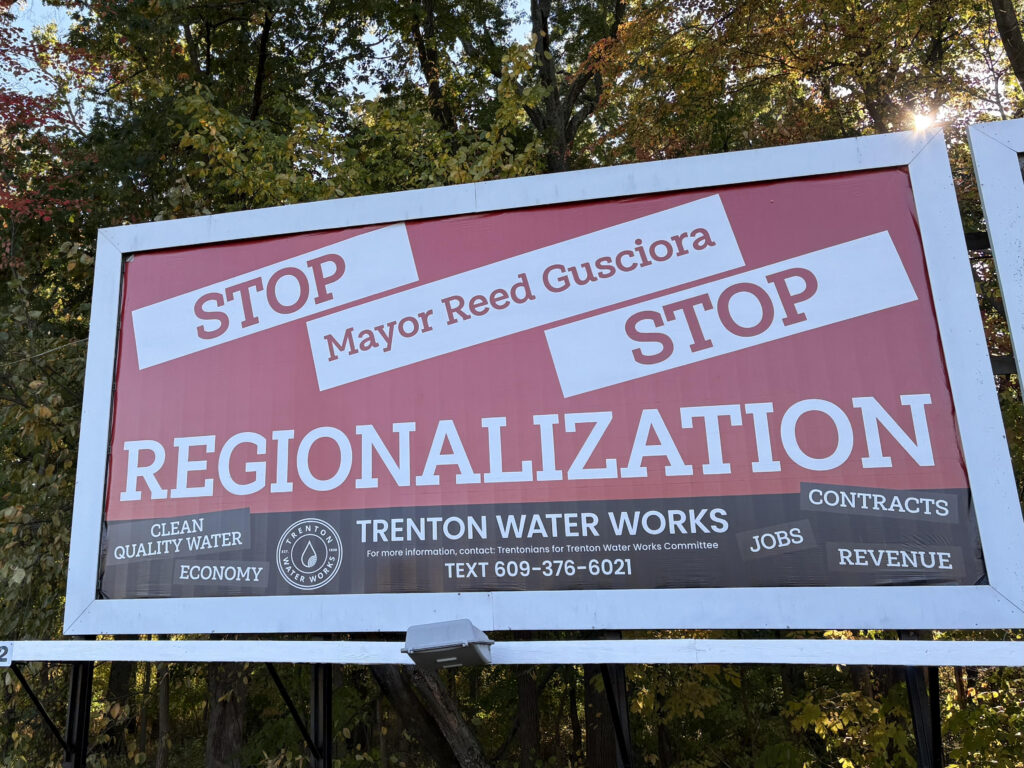
But many residents are adamantly opposed to this solution. The loss of jobs and city revenue, as well as the potential for surging water prices, are the main reasons citizens give for opposing this change. Trenton resident and community activist Caroline Clarke has discussed her opposition to regionalization in many public meetings, where she’s noted that although there are problems, “Nothing about any of those problems justifies selling Trenton Water Works.”
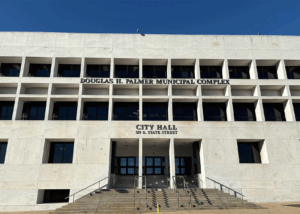
Trenton City Council has created a new ad hoc committee dedicated to discussing TWW issues. [Credit: Lara Becker]
Marc Leckington, a Trenton resident who runs a blog dedicated to reporting on TWW issues, feels that the need for a backup plan is crucial, and that in the event of a catastrophe, privatization would provide the quickest solution. For example, Leckington said, a company like American Water could step in and assist with its larger pool of resources. “We’re not going to have the luxury of a two-year study to form a utility, an authority, and all those sorts of things,” he said.
In a separate attempt to address water troubles, the townships of Hamilton, Lawrence, Ewing, and Hopewell have joined NJDEP in a lawsuit against TWW. The suit was first filed in 2020, and has strengthened in numbers in 2025. The townships aim to sound the alarm regarding the urgency of the issues and strive towards actionable change.
“Trenton should be a world-class city,” said Ewing resident Joshua Weinstein. To public officials, he pleaded, “You want Trenton to be a place not just where the drinking water is safe, but where people are willing to move to and buy homes, and [now] they can’t even trust the most basic of infrastructure.”
While city and state officials leave arguments over the water system unresolved, in the interim, 225,000 residents are left to question what they are getting when turning on the tap. With capital improvements still well underway and an assessment not due for another year, it seems that for the time being, the waters of Trenton will remain stirred.
Related Posts
February 20, 2026
Too Many Warehouses: Industrial Expansion Meets Community Resistance in a California Town
Perris residents are pushing back against the proliferation of warehouses as city leaders impose a 10‑month hiatus on new industrial development. "How is it possible that a park is boxed by shipping containers?" asked one resident.

December 20, 2025
When the Internet Turns on Its Storytellers
Digital Journalist Meghann Cuniff Discusses Navigating Online Visibility