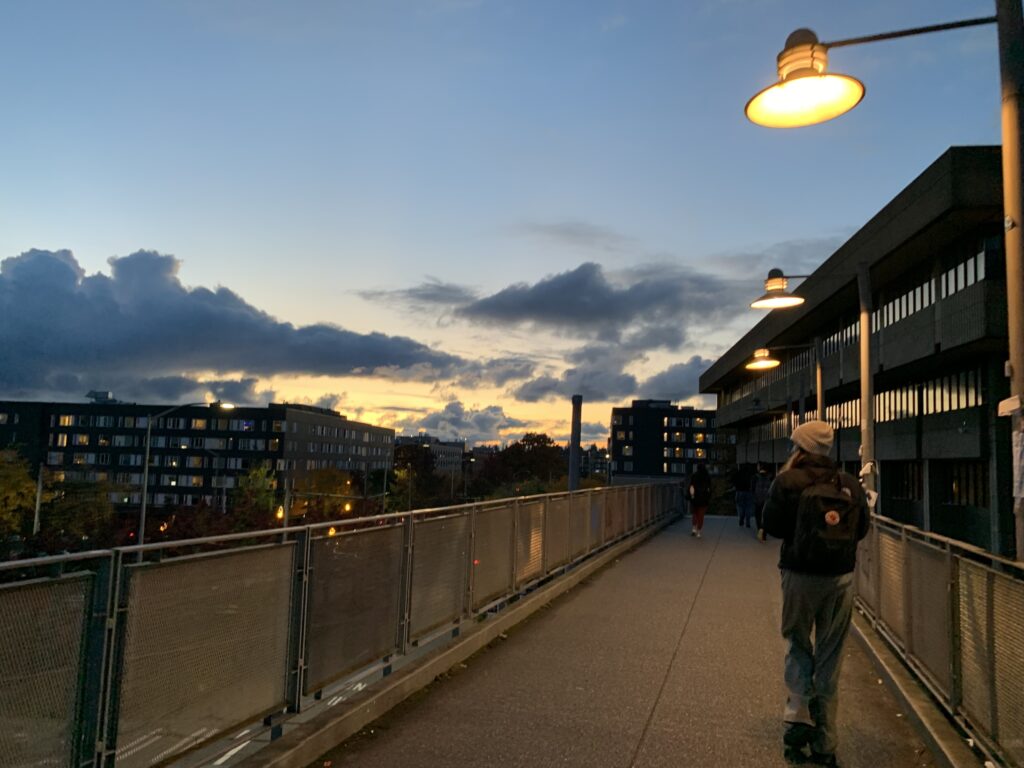
(SEATTLE) — It was around 10 p.m. on a cloudy August night. Mollie Chehab walked along University Way Northeast with a friend. She keeps to her unwritten rules of city living as a woman: walk with a friend, be aware of your surroundings, carry pepper spray. As the pair turned onto Northeast 42nd St., glancing to their left at Magus Books, a man emerged from the alleyway in front of them swinging his arms and attempting to spit at them.
“This guy pops out of the shadows and starts trying to swing at us and spit on us, and starts yelling profanities at us,” Chehab recalled. “And I feel like it was one of those situations where he really caught us off guard.”
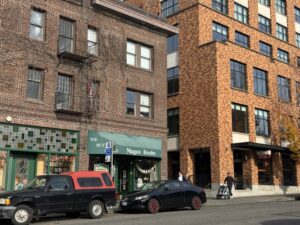
The alley next to Magus Books on Northeast 42nd St. where a student was walking one night when a man jumped out at her. [Credit: Emily Iris Dickinson]
Property crimes and low-level disturbances are common on The Ave, a popular destination for university students. What’s more is there’s a “1-in-16 chance of becoming a victim of crime” within the University District, according to AreaVibes, a private website that rates livability, including crime trends, for Seattle and other U.S. cities. Its crime data may differ from official crime reports.
“You hear about all [of] these incidents happening to other people, but having it happen to you is definitely a lot more alarming,” Chehab said. “I feel like the hard part, too, is kind of figuring out how to handle it, because, again, it can catch you off guard. And then in my situation, we were like, ‘Well, the police aren’t gonna come for like 40 minutes probably.’” Believing the man may have been in crisis, she said, “Like, is that really gonna do anything? Like, if the police just come and tell him to stop he [might not] understand that.”
Other students feel that their experience isn’t bad enough to report, or the police won’t come in a timely manner, or that it’s just a part of city life. However, when incidents like Chehab’s aren’t reported, city crime data can’t accurately reflect what’s truly going on. The Click dug into this to find the disparities between reported and perceived crime by listening to the perspectives of residents and safety personnel.
Who responds in the U District?
Seattle’s University District hasn’t seen any major changes in crime data in the past few years. However, as an area with crime above the national average, residents and workers feel unsafe. This perception is shaped by unreported crimes, slow emergency responses, and confusion over who to contact for emergency services.
According to the public affairs office of the Seattle Police Department (SPD), “the most common crime type reported in the University District is basic theft with 995 reports in 2024 and 840 in 2025,” showing a downward trend. However, since this data is incomplete, this year’s number will likely rise over the next month.
Aggravated assault is the highest reported violent crime in the University District, according to the Seattle Police Department Crime Dashboard. Violent crimes are characterized by the use of force or threat of force, according to the Federal Bureau of Investigation (FBI). The crime dashboard shows trends of a slight increase in overall crime in the University District but that property crimes as a whole are downtrending. The SPD’s public affairs office wrote to The Click saying that “the University District is … down an average of 17% [so far] in 2025 [compared to] 2024.”
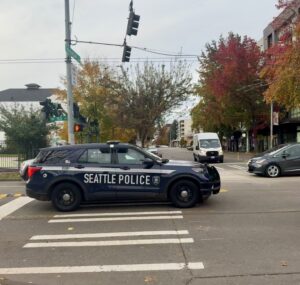
In 2024, the average response time for police dispatched for the most urgent emergency calls was 13.8 minutes, according to city data. Here, a police car is turning onto The Ave in the University District. [Credit: Emily Iris Dickinson]
The SPD’s public affairs office informed The Click that “there are hard borders for where UWPD is responsible and where SPD takes over. We do share a great deal of information back and forth, but when talking about police response, that is very rigid.”
Although some residents expressed confusion over who to call, the SPD’s public affairs office said, “It’s nothing the caller would ever need to worry about when they call 911. If you tell the operator you are on University Way outside the UW bookstore, they know to dispatch Seattle PD. If you call 911 from outside the Burke Museum, the operators know that [it’s] UWPD.”
The UWPD did not respond to multiple requests for comment.
The role of safety ambassadors
One local organization residents can lean on for safety is the U District Partnership program. It consists of programs that focus on economic development, safety, marketing, urban vitality, and homeless outreach, according to its website.
The partnership employs safety ambassadors who direct visitors, help the unhoused population, and assist businesses with security issues in the district until 11 p.m. most nights and 10 p.m. on weekends. They receive training as unarmed security personnel, according to Don Blakeney, executive director of the partnership program.
“The main training is about de-escalation,” Blakeney said. “Using verbal cues to de-escalate a situation, understanding that there’s things you could do in a situation you might not realize could be triggering for someone who’s suffering … and so just really understanding how to approach a situation carefully, and then also knowing [when] to extract yourself from a situation.”
Shared enforcement between the SPD and UWPD with aid from the partnership program seems helpful, but, according to residents, can be confusing in practice.
9-1-1, please hold
Helena Schmitt has worked as a shift lead at Cafe on the Ave for just under a year. When she moved to the University District, “a lot of people were complaining about how bad it was living in the district or close to The Ave,” she said. “Nothing really ever happened to me personally — like I got followed once I think — but it wasn’t anything crazy. So, I think I expected it to be a lot worse than it actually felt.”
Schmitt has encountered this reaction from others who claim The Ave is a dangerous place to work. Despite these reactions, Schmitt has found the incidents to be relatively minor from individuals coming in half-clothed to people throwing around chairs.
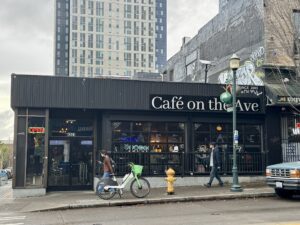
Cafe on the Ave where some staff say the police are slow to respond. [Credit: Emily Iris Dickinson]
Last summer, he was tasked with moving a domestic argument away from the front of the business. When he attempted to do so he was “promptly attacked” by one of the men. The man’s friend “pulled a knife on me and so I ran and called the cops,” Jacob recounted. “They were there within 10 minutes. [Response times] can be hit or miss though.”
When asked why ‘it can be hit or miss,’ Jacob said, “We honestly deal with most issues ourselves because the police don’t show up. Unless there’s a weapon pulled, they won’t show up.”
Although this is the most serious crime Jacob has encountered in the area, he still perceives The Ave to be “a lawless zone” due to long police response times.
Schmitt shares similar frustrations with Jacob when it comes to the actual response times. The police take too long, the ambassadors are unarmed so when an armed individual shows up at their business, they aren’t as effective, and The Ave is right outside of the UWPD’s jurisdiction, she conveyed.
“I definitely think there’s something missing, almost,” Schmitt said. “Someone I could call that’s gonna be there quickly and can actually de-escalate the situation.”
After being put on hold by 911 operators twice, she added, “I have absolutely given up on calling the police ever.” She prefers calling the U District Safety Ambassadors for incidents involving mental health crises and property crime.
According to data collected by the city council’s public safety committee, the SPD logged an average response time of 13.8 minutes for Priority 1 emergency calls in 2024 in the North Precinct, which includes the U District. Priority 1 calls “involve incidents creating risk to life or serious injury, crimes in progress, officer or firefighter safety, and other emergency events,” according to the Seattle City Council blog.
The response gap
“For me, [it] comes in waves,” Chehab reflected, referring to her sense of safety.
Her experiences on The Ave and surrounding areas have affected her college experience. “It can be anybody doing these things,” she explained, citing petty theft and other minor crimes or disturbances. “And so I think it’s also like being aware of the stereotypes that a lot of times are created when these incidents happen, and not allowing those to influence how we treat people. Especially if somebody’s in need of help.”
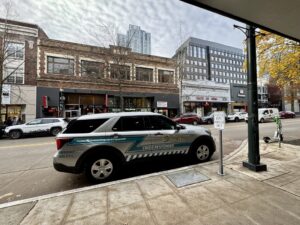
A CARE CCR vehicle parked on University Way Northeast. [Credit: Emily Iris Dickinson]
Along with this team is the Community Assisted Response and Engagement (CARE) Department’s Community Crisis Responder (CCR) program. While the Crisis Response Team sends mental health professionals with police officers in response to behavioral issues, the CCRs are behavioral health professionals who “respond to calls that do not require enforcement of any kind,” according to the CARE Department website.
“CCRs are dispatched by the Seattle 9-1-1 Communications Center or directly radioed to assist by Seattle Police Department patrol officers,” the CARE Department website said.
With these various systems in place, residents have multiple resources to lean on. The fact that SPD statistics show violent crime rates at the same level or lower than past years, doesn’t necessarily align with the perceptions and feelings of the community the numbers come from.
The gap between crime statistics and perception is feeling safe. “Even if I have my pepper spray on me I still have that pit in my stomach of ‘something could happen,’” Chehab said. “I think that’s probably the worst part — that unknown.”
Correction: This article was updated to remove a quantitative crime comparison, to add material explaining Seattle’s Community Crisis Responder program, and to correct the subject identified in the final photo.
Related Posts
February 20, 2026
Too Many Warehouses: Industrial Expansion Meets Community Resistance in a California Town
Perris residents are pushing back against the proliferation of warehouses as city leaders impose a 10‑month hiatus on new industrial development. "How is it possible that a park is boxed by shipping containers?" asked one resident.

December 20, 2025
When the Internet Turns on Its Storytellers
Digital Journalist Meghann Cuniff Discusses Navigating Online Visibility