[ LAKE WORTH, Fla.] — It had been there all along, but I’d never really seen it. Hanging on the wall of my grandfather’s bedroom lay a framed cutout of an embroidered tablecloth.
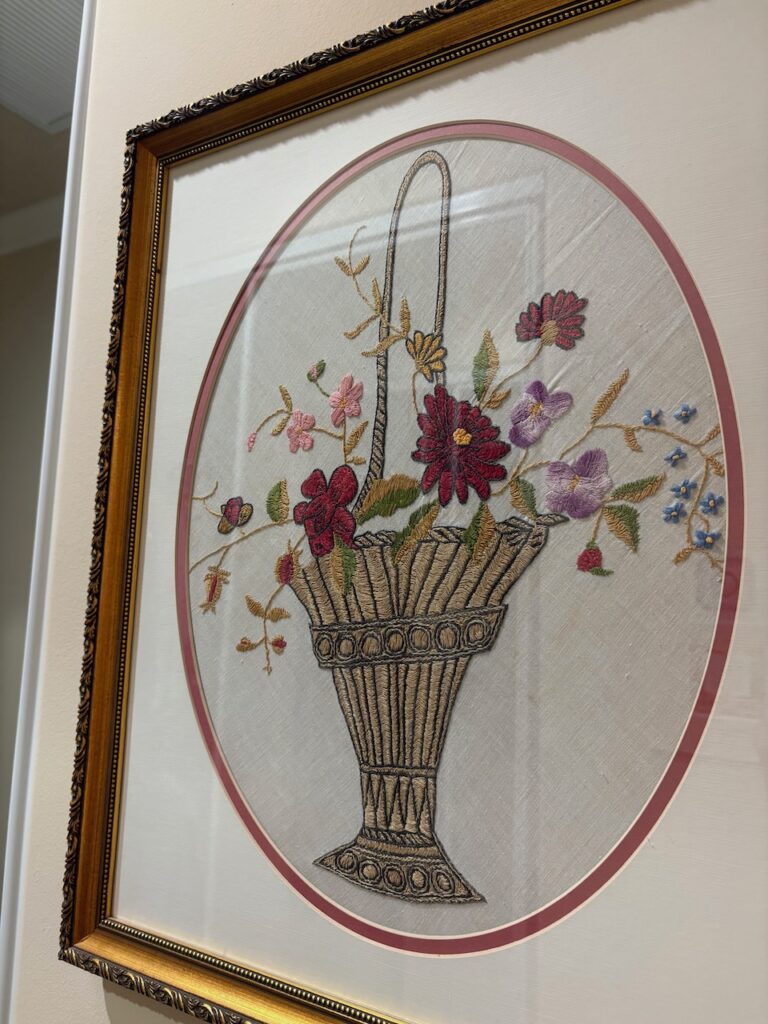
The tablecloth was embroidered by my grandfather’s aunt, and pieces of it were split between my family. [Credit: Lara Becker]
The tablecloth was embroidered by his aunt, Runie Steckman-Einhorn. It was preserved by my great-grandmother Fannie, Runie’s sister, who had it cut and divided between her children and grandchildren as a family keepsake.
“If you take the piece down, flip it over, and remove the frame,” my grandfather told me, “you’ll see a small black and white photo taped to the back.”
A father, two sisters, a brother, and a baby — clearly having a hard time sitting still — perched on a grandmother’s knee. Their faces are solemn but poised, and you can tell they’ve been assembled for the photo with care. The date was December 1931 in Linflatz, Poland; it was Runie’s wedding.
She’s the one on the top right, and was marrying the man to her lower right, named Moishe. To the left of Runie is her soon-to-be sister-in-law, who’s name is not noted. In the bottom row, left, is my great-grandmother’s brother, Samuel, and in the middle holding the baby is Moishe’s mother, Leah. The baby is Samuel’s son.
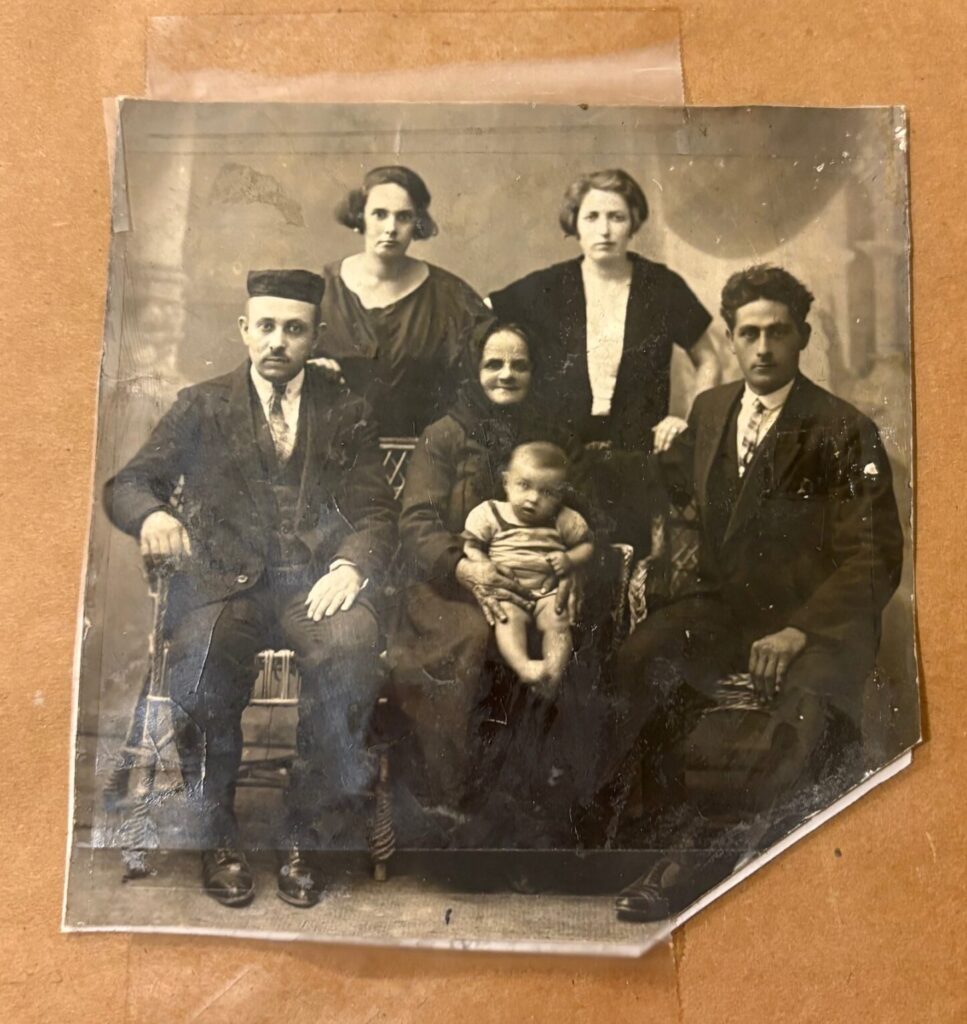
The photo on the back of the picture frame shows my great-grandmother’s sister Runie, surrounded by family on her wedding day. All later perished in the Holocaust. [Credit: Lara Becker]
But my great grandparents, Runie’s sister and brother-in-law, Fannie and Simon did make it out.
They not only made it — they thrived in the U.S., with a home of their own, a window-washing business Simon started from scratch, and three children. And because of that fact, I’m here to rediscover their long journey to a new home.
Mis-remembered history
Simon and Fannie’s story was hard to unravel. By 2026, each member of my family had been carrying around different versions of it.
My mom thought Simon immigrated alone, only seeing a photo of him from one of two voyages. My uncle thought Simon was 14 when he came over. Perhaps embarrassingly, I always pictured Simon coming over on a tiny rowboat with an infant brother on his hip.
It seemed that with each coming generation, the story got further and further away from the truth, like a bad game of telephone.
So when I was ready to find out the real version, I sat down at my parents’ kitchen table back in New Jersey, sifting through piles of Simon and Fannie’s photographs and documents: the work of my grandfather’s meticulous preservation, now held by my mother.
Social security cards, naturalization papers, passports, licenses, and photos, which my mom now keeps tucked away, locked safe in her home. The naturalization papers are sealed in clear folders, and each passport is carefully ensconced in a manila folder. As I flipped through each document, I could almost feel each of them re-appearing right in front of me. I’d never met Simon or Fannie, but suddenly, here they were.
A 13-day wait in Ellis Island wasn’t the hard part
Simon Wohl was 19 and his brother Harry was 17 when they boarded a steamship in Hamburg, Germany to take them to Ellis Island in New York in 1922. Their home was Chorostkov, Poland, which is now a part of western Ukraine. It was also sometimes noted as part of Austria-Hungary.
In writings on JewishGen, Chorostkov is described as a small town well-known for its “Yarid” or weekly market, as well as for its craftsmen: carpenters, ironmongers, furriers and hat makers. This was a place where all the store owners were Jews. But education wasn’t a priority, especially after WWI. According to the JewishGen writings, there were no trade schools or high schools in Chorostkov; knowledge had to be sought on your own time. And so, off to America they went.
Before boarding the ship in Hamburg, Simon and Harry were asked intake questions for Ellis Island, which are now often referred to as “the 29 questions.” Some sources say it was actually closer to 31 questions by 1924. They included the typical demographic inquiries, but also questions like: “are you a polygamist?” and “are you an anarchist?”
Luckily, Simon and Harry said no to both, so they were cleared to board.
On Ellis Island’s online database, I was able to locate the actual ship manifest from their voyage, which told me that the name of the ship that carried them to America was called “Mount Clinton.” They boarded on December 28, 1922 and arrived in New York on January 11, 1923.
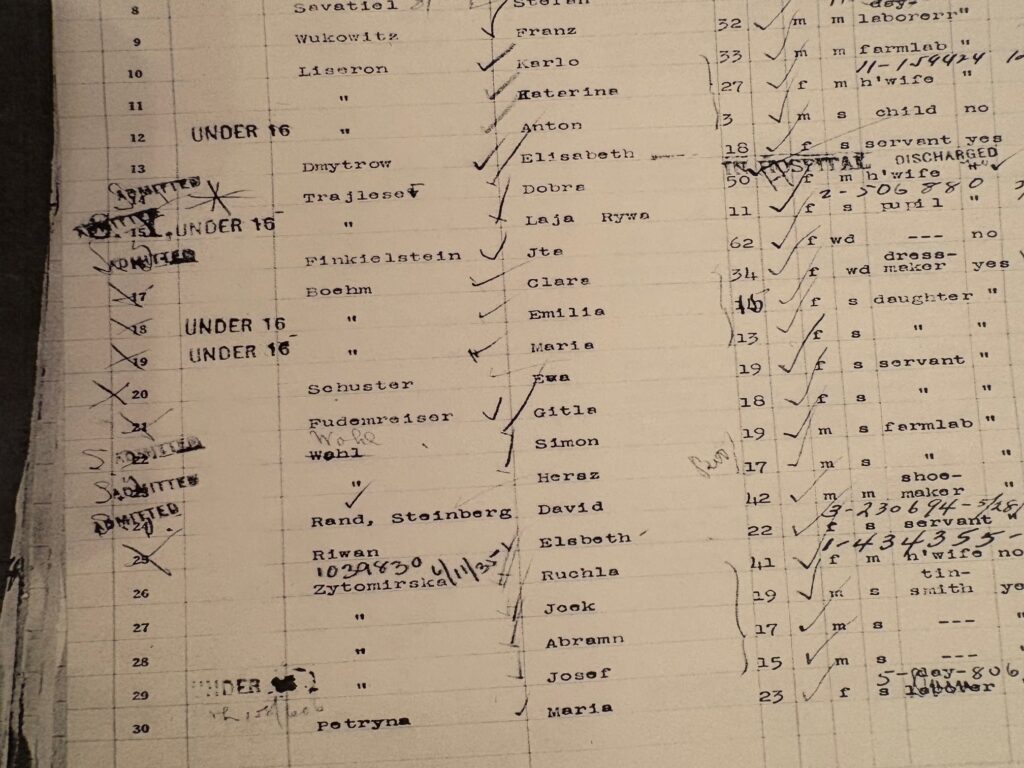
The ship manifest that recorded Simon and Harry’s journey to the U.S. They are numbers 22 and 23. [Credit: Ellis Island documents purchased by Lara Becker]


You can see that their name was originally written as “Wahl,” but was crossed out in pencil to become the more Americanized “Wohl.” Simon’s occupation was listed as “farm lab,” which was most likely referring to farm labor. Harry’s details, besides his name and height, only had the marking for “same as above.”
Timing was a theme to their story from the very beginning. They survived the bitter cold of the ship, but it likely wasn’t much warmer on the floors of Ellis Island, either.
Once they de-boarded the steamship, passed their examinations, and got inside, Simon and Harry waited 13 days in Ellis Island for their sponsor, an older half- brother, Sam, to pick them up. Sam came from Poland in 1914 and lived in the Bronx with his wife. He was in the milk delivery business and couldn’t find time to get away. He’d received a form to fill out in the mail, which certified his naturalization, making him permitted to sponsor the two and pick them up.
My grandfather said that if Sam hadn’t picked them up by day 14, they would have been sent back to Poland. You can almost imagine Simon and Harry, sleeping and eating, sitting and waiting. Hoping that it would all work out, but not really knowing if it would.
Once finally making it to the Bronx, Simon and Harry stayed with these relatives for a short while, but then moved to Brooklyn where they knew of other Jewish immigrants. Ever the self-motivator, Simon used his connections to start a window-washing business. As my grandfather described it, “Retail stores were popping up all over the place. Each storefront had very large plate glass windows. He was the businessman, Harry would be the helper. Whatever he made, he shared with Harry.”
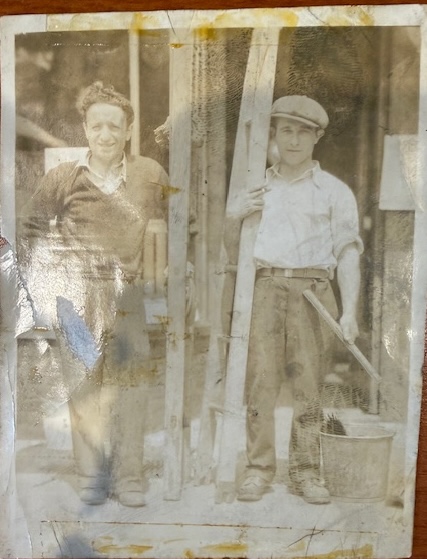
Simon and his brother, Harry, working at their window-washing business in New York. [Credit: Hal Wohl]
Before leaving Chorostkow, Simon had promised a girl that one day, he would come back, bring her to America, and marry her. And if there was anything to know about Simon, he was a man of his word. “If he said he was going to do something, he did it!” my grandfather said.
In a move that seems almost herculean, he went back to Ellis Island in 1928. He boarded a steamship once again, and arrived back in Poland to summon his wife.
Her name was Fannie, or Feiga in Yiddish. Fannie lived in the village of Husiatyn, which was located in the same Polish province of Galicia, not far from Chorostkow.
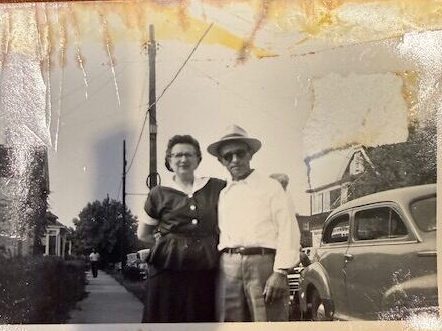
For some reason, the photo we have of my great grandfather on a steamship is from this journey — heading back to Europe. He’s standing front row, center, in a white hat.
When Simon returned to Poland, he wasn’t just vying for Fannie to join him in New York. He wanted her whole family to join them, too — the people in the black-and-white image on the back of the picture frame. This part of the story was new to me.
Simon’s family felt it was important to come to America. At least two of Simon’s half brothers, Sam and Morris, had emigrated to the U.S. in the 1910s. My grandfather said Simon would often receive correspondence from them, telling the family about the better lives and jobs they had found. In the U.S., there was plenty of work to go around: in the early 1900s, many American cities were looking for workers to help fuel industrialization.
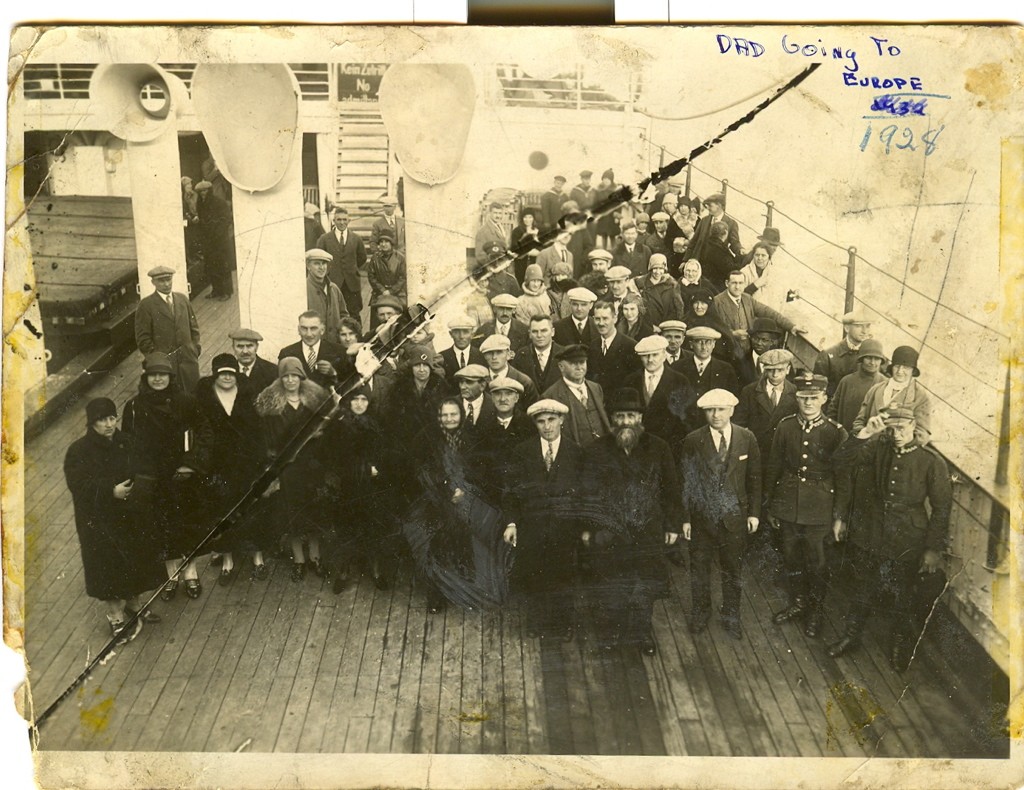
Simon on the boat back to Europe to bring his wife, Fannie, to America. He is standing front row, center, in a white hat. [Credit: Hal Wohl]
Fannie’s family wished her well, and gave their blessing for her to travel to New York with her soon-to-be husband in 1929. Both of their passports were stamped, and they were off. Unfortunately, this would be the last time she would see them.
A new start is someone else’s end
While Simon and Fannie were starting their new beginnings in America in the early 1930s, war was brewing in Europe. And, their “fresh start” couldn’t have been more different for husband and wife. In immigration stories, arrival is often framed as savior. But even in the same marriage, under the same household, survival was imperfect.
Simon watched his business boom. He was making real money for the household and even bringing in business partners. He eventually owned his own home in Brooklyn. My grandfather said he learned how to speak English by reading “The New York Times” every day, and by surrounding himself with only English speakers. He said his father’s English became so impeccable that he lost most of his accent.
Fannie received a telegram that changed everything. We don’t know exactly when, but likely in the late 30s or early 40s, she received word that her whole family had died in WWII. It is reported that by 1942, a majority of Poland’s Jewish population had been killed, either in acts of random killings, or in concentration camps. It’s estimated that three million Polish Jews were killed in the Holocaust. She likely wasn’t given much more information than that they had perished.
“She had a nervous breakdown,” my grandfather said. “She was alone, completely alone,” he said. At the time, she even stopped keeping Kosher, and withdrew from any activity outside of the house.
But, my grandfather (the youngest child) was very small when the loss occurred, so by the time he grew up, what he really saw were the after-effects. It took her a long time to learn English, and she never became fully proficient in it. She never worked, and neither she nor her husband were educated beyond elementary age, due to WWI in Poland. Any education had to be taken upon themselves, and my great-grandmother was too saddened to participate.
Fannie’s story is harder to tell, if not for the simple fact that it was told less. By the time my grandfather was old enough to have meaningful conversations, there was an unspoken rule: their past is not to be talked about.
“They were very secretive —not because they were embarrassed, just because they didn’t want to think about the unhappy memories,” he said. “I never sat down with my father asking him questions about [their story.]”
Perhaps for this reason, my grandfather took it upon himself to keep every record, every photo he could find of his parent’s lives. His older brother and sister weren’t quite as interested. For my grandfather, this was how he was going to keep his family alive. And, he certainly succeeded.
Answering my own questions
As I reconcile with what’s on Google and what’s in our family stories, I still have so many questions. Are the details we think we know correct? What was Simon’s real motivation for getting himself to America at age 19? What really happened to Fannie’s family in the war?
I consulted Jeremy Frankel, a genealogist who conducted research for the television series “Who Do You Think You Are” and “Finding Your Roots,” and now works with clients to help them parse through familial records. Frankel is no stranger to complicated “family mysteries,” as he likes to call them.
“Many people become interested and involved in researching their family history because of a family story. Sometimes it’s true, other times it’s proven to be patently false,” Frankel told me in an interview.
“One aspect about genealogical research… is you wear more than one hat,” he said. “There’s the research/investigative hat, but then there is also the censor’s hat (do I reveal everything I find?) You might also wear the confidant’s hat. There are probably other hats too.”
Which hat do I wear now?
The future
The documents are pristine, the photos are spectacular — but that’s not really the important part.
The legacy beyond the photographs is me. It’s my grandfather, his siblings, my mom, my uncles, cousins and many, many grandchildren.
Without Simon’s strength and determination to come to America, none of us would be here. An entire generation, and generations upon those generations, would have never had the chance to exist.
“Had he not had the guts to come over here, none of this would have happened. He’s the one that everyone should go ahead and say thank you to,” my grandfather said.
As part of an age-old Jewish tradition, we soon learned how to say thank you.
Locked in the safe with Simon and Fannie’s papers, licenses, social security cards and other pristine records, there was one thing out of place. It was a printed email between my mom and grandfather.
It’s dated up at the top in pen: “May 8, 2003 – e-mail from Robyn.” They’d all been discussing what to name her second child, who would be born that year in August. Now, they were thinking about Simon’s American nickname: Sam.
“Do you think it’s bashert [meant to be] that ‘Samuel’ means ‘answer to prayers’?” my mom asked in the e-mail. “How bout the fact that I just borrowed a book for Lara from the library about a mommy and a little girl and the mommy is pregnant with her second … At the end of the book, baby’s name is Sam.”
Sam became my little brother. This fall, he started law school.
Although my great grandpa Simon didn’t have much of a formal education, he was determined and inspired to learn everything he could about the world. “You go to school, you go to high school, college — if you went beyond that, even better. His interest in education was huge,” my grandpa said of his father.
When I came into this project, I thought I was there to get all my questions answered. I wanted to match Simon’s hunger for knowledge; I thought I’d uncover a huge plot twist, or some juicy family story. But what I came out with was a deeper understanding of these living, breathing people. The passports and documents are fascinating, but what I really know now is that this story is deeply human.
We don’t evolve flawlessly —there’s no way we can. But maybe if we’re lucky, we’ll all have someone to save tiny bits of our lives in a manila folder. To have our future children know that we weren’t perfect, but at the very least, we kept moving forward.
Related Posts
October 8, 2026
At 53, Simone Is Reinventing Her Life — Again
After teaching Portuguese for three decades, it's time for something different.

August 28, 2026
Michael Carrino Is Enjoying His Second Act
The Akron-based actor spent the past decade building his career in theater, film, and television. Now, he’s taking on his biggest role yet as Dr. Francis Sweeney in “Kingsbury Run.”