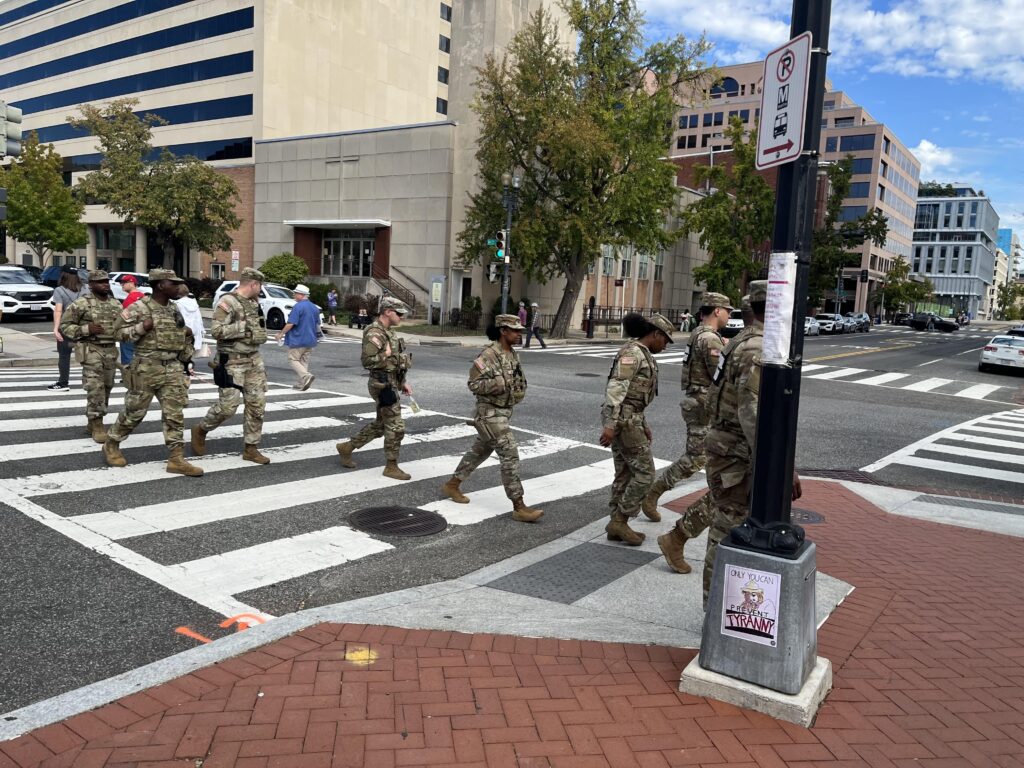
(WASHINGTON) — On a still Saturday afternoon in the normally bustling heart of Columbia Heights, a faint thrum of drums begins to build. A police cruiser edges across the roadway to block traffic, lights pulsing but mute. Soon a sudden rallying cry, “Down with the fascists!” cracks through the crisp fall air, echoing down 14th Street the DC neighborhood’s main artery. Dozens of demonstrators round the corner, anti-Trump signs raised, chants overlapping slowing briefly near a line of stone-faced National Guard soldiers before pressing on.
“I saw a guy get snatched up down the street from here a couple days ago,” a fellow onlooker tells me in a hushed tone, eyes fixed ahead as we make small talk about the police presence in the neighborhood. “I wanted to film, or help somehow, but it happened so fast.”
I hadn’t explicitly prompted a conversation about immigration enforcement, yet the subject seemed to be top of mind. And just as quickly as the crowd materialized, the demonstrators dissolved down the avenue tailed by police vehicles, leaving behind an unsettling quiet. The street slipped back into its usual rhythm.
In Ward 1, where neighborhoods such as Mount Pleasant and Columbia Heights have some of the highest concentrations of Latino residents across the city, that uneasy whiplash has become routine. Earlier this summer the district was at the center of near-daily immigration raids as federal authorities ramped up enforcement — Trump claiming a city in the grip of an “out-of-control” public-safety crisis despite Metropolitan Police Department (MPD) figures showing crime at a thirty-year low. Now, in the takeover’s immediate aftermath, the city feels embalmed in an eerie, subdued quiet; beneath the surface, inside immigrant communities, people are adjusting to a quieter but more pervasive state of occupation.
Capital takeover
On Aug. 11, Trump declared a 30-day emergency takeover of Washington, invoking Section 740 of the D.C. Home Rule Act to assert federal authority over the city’s police department. National Guard troops and multiple federal agencies, including U.S. Customs and Border Protection agents, were deployed into city streets, sweeping up unhoused residents and swelling already overcrowded jails and immigrant detention centers.
By September, after weeks of public threats from the White House, DC Mayor Muriel Bowser issued a parallel emergency order authorizing temporary cooperation between MPD and federal officers. Steadily, what the administration branded a “crime crackdown” blurred into an immigration dragnet that, according to attorneys at the Washington Lawyers’ Committee for Civil Rights and Urban Affairs, relied on racial profiling and overwhelmingly targeted Latino neighborhoods like Columbia Heights. An Associated Press analysis of the month-long takeover found that roughly 40% of arrests were immigration-related.
As summer turned to fall and the emergency order stayed in effect, everyday city spaces — primary schools, daycares, clinics, churches, bus stops, restaurants, even food-pantry lines — suddenly found themselves at the frontlines. Police erected ad-hoc checkpoints in high-traffic corridors during rush hour, often in tandem with federal officers, stopping and questioning drivers and detaining immigrants regardless of legal status. Online, videos surfaced showing teams of masked agents spilling out of unmarked vehicles on quiet residential streets, whisking away unsuspecting trades workers behind tinted windows. In other scenes, individuals were tackled by clusters of officers while MPD officers cordoned off sidewalks to keep distressed bystanders back.
A district under siege
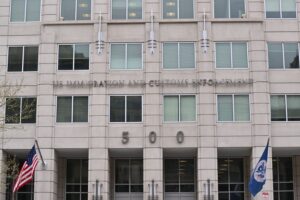
An Immigration and Customs Enforcement building in Washington D.C. [Credit: Pexabay]
At an Oct. 29 Public Works and Operations Committee roundtable, Ward 1 residents and organizers described a community living under siege. “People are afraid to buy groceries, to go to work, to seek help,” Madhvi Bahl of the Migrant Solidarity Mutual Aid Network (MSMAN), a grassroots coalition that supports migrants, testified. “We’ve had to multiply deliveries fivefold just to meet the needs of families who no longer feel safe leaving their homes.”
Since January, MSMAN has operated a 24/7 hotline for immigration emergencies. When federal presence intensified on Aug. 11, calls spiked sixfold — from 743 in the prior 79 days to 4,852 in the weeks that followed. A parallel project, Film the Police D.C., launched Sept. 2 to collect documentation of law enforcement encounters; nearly 1,000 videos poured in within weeks.
“To say that D.C. residents are traumatized by the surge of federal agents and stepped-up immigration enforcement is not hyperbole,” Ward 1 Councilmember Brianne K. Nadeau told the roundtable.
Yet residents say answers from city leaders have been scarce. According to activists, calls to the mayor’s office and the D.C. Attorney General concerns about ongoing cooperation with federal agencies have largely gone unanswered. In a statement to The Click, MPD spokesperson Tom Lynch said coordination with federal law enforcement “did not end with the conclusion of the emergency period,” pointing to a mayoral release in early September that outlined continuing joint operations.
Forced into hiding
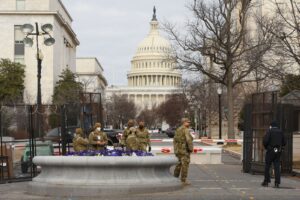
National Guard troops stand near a security checkpoint outside the U.S. Capitol in Washington. [Credit: Pixabay]
At a small café in Mount Pleasant, a longtime business owner who asked not to be named, told me about the impact. “Customers have been afraid to come out, so many are not working and therefore don’t have the money to come to the café — or they’re too scared to risk being out,” she said.
Before August, her regulars included workers from nearby shops and construction crews who grabbed breakfast on their way to jobs. “Now the workers don’t want to leave their business and risk it on their break, and they’ve had a drop in business too. The contractors and landscapers don’t come like they used to because they stopped working for a while and have less work in Mount Pleasant.” Inside the café, the mood is heavy. “Some days the street is dead,” she told The Click. “Sometimes my staff is worried about raids nearby. Some of my staff have people close to them who have been deported and they are consumed with that during our workday.”
On Labor Day, the cafe owner was off work and lying in bed when a neighbor’s shouts jolted her awake. “I heard someone screaming for the goons to leave,” she said. By the time she ran outside, agents were already closing the car doors and pulling away.
One food bank nonprofit director, who requested anonymity for the security of staff and clients, described the initial weeks after the takeover as a time when “the community went into hiding.” Outside his organization’s building, he recalled, nearly two dozen people were detained in a single sweep while waiting for the doors to open for food assistance.
Demand for food from his nonprofit has climbed by roughly 25%. Yet attendance at in-person distributions has dropped nearly in half. “Families are weighing every errand against the possibility of being arbitrarily questioned and detained,” he said. “Some have decided it’s simply not worth stepping outside.”
Down the street, the Shrine of the Sacred Heart Catholic parish, long doubling as a community center in the district, has become a barometer of the crackdown’s toll. A church leader told reporters last month that roughly 40 parishioners have been detained or deported since the summer.
Paramilitary patrols
A dizzying array of agencies appear in these operations: Department of Homeland Security units, Border Patrol personnel, U.S. Park Police, even IRS criminal investigation officers alongside MPD patrols.
William C. Banks, founding director of Syracuse University’s Institute for National Security and Counterterrorism, told me the mix of camouflage, tactical gear, and opaque chains of command marks a shift toward paramilitary-style domestic enforcement.
“It’s massive, we’ve never seen it before,” Banks said. “Americans expect law to be enforced by police — our neighbors, trained to protect rights. Military forces are not trained for civilian contact. They come from elsewhere. It’s scary.”
Banks and other legal scholars say Trump’s summer invocation of Section 740 and the mass detentions amounted to a significant erosion of the capital’s sanctuary protections. Because D.C. is not a state, local officials have limited legal authority to block federal intervention, leaving immigrant communities particularly exposed.
“D.C. is fundamentally in a different situation than what we are seeing in other cities now,” he said. “The mayor is not commander of the Guard — the President is. There is very little the city can do to prevent federalized immigration enforcement.”
Adapting to a new state of occupation
Organizers say there has been little time to process the shock. Instead, energy has shifted toward improvised systems of care: volunteers coordinating school drop-offs for children whose parents are too afraid to leave home; food pantries converting entirely to delivery; church basements hosting know-your-rights training late into the evening.
Even as Trump touts the Washington operation as a “model of success” for crackdowns in other Democratic-led cities, residents across the capital report little sense of relief as they watch enforcement patterns in places like Chicago and Los Angeles with mounting unease.
“We are hearing from people that they have been scared to leave their homes, to make money, forced to make hard choices between paying rent or having food,” Natacia Knapper, an organizer with Ward 1 Mutual Aid, told The Click during a Free DC neighborhood gathering in early November.
Just as communities in the capital were beginning to adapt to a more subtle, pervasive state of occupation, the shooting of two National Guard troops on the eve of Thanksgiving left residents holding their breath for a renewed siege. After the killing of National Guard Specialist Sarah Beckstrom, 20 and the critical wounding of Staff Sgt. Andrew Wolfe, 24, the president announced the deployment of 500 more National Guard troops to the nation’s capital.
Rahmanullah Lakanwal, a former member of a special CIA unit during the American deployment in Afghanistan, has been charged with murder and assault in the case, according to the Associated Press. Lakanwal struggled with mental health since his arrival in the United States as part of a resettlement program for Afghans evacuated following the Taliban takeover in 2021, the AP reported.
While it is still unclear whether this latest show of force by Trump will be coupled with the violent immigration enforcement raids that defined the summer, residents are increasingly certain of one thing: with the capital under the thumb of a president who can flood its streets at will, no mayoral promise—and no sanctuary laws—can guarantee that this will be the last time.
Related Posts
December 8, 2025
Seattle’s Safety Gap: When Feeling Safe and Being Safe Don’t Align
Seattle's University District hasn’t seen any major changes in crime data in the past few years. However, as an area with crime above the national average, residents and workers feel unsafe.
December 8, 2025
‘On the Brink of Catastrophic Failure:’ How Long Will Trenton Water Works Keep Working?
Trenton Water Works serves approximately 225,000 people and is over 200 years old. After years of neglect, the utility is grappling with aging infrastructure, staff shortages, and health concerns.