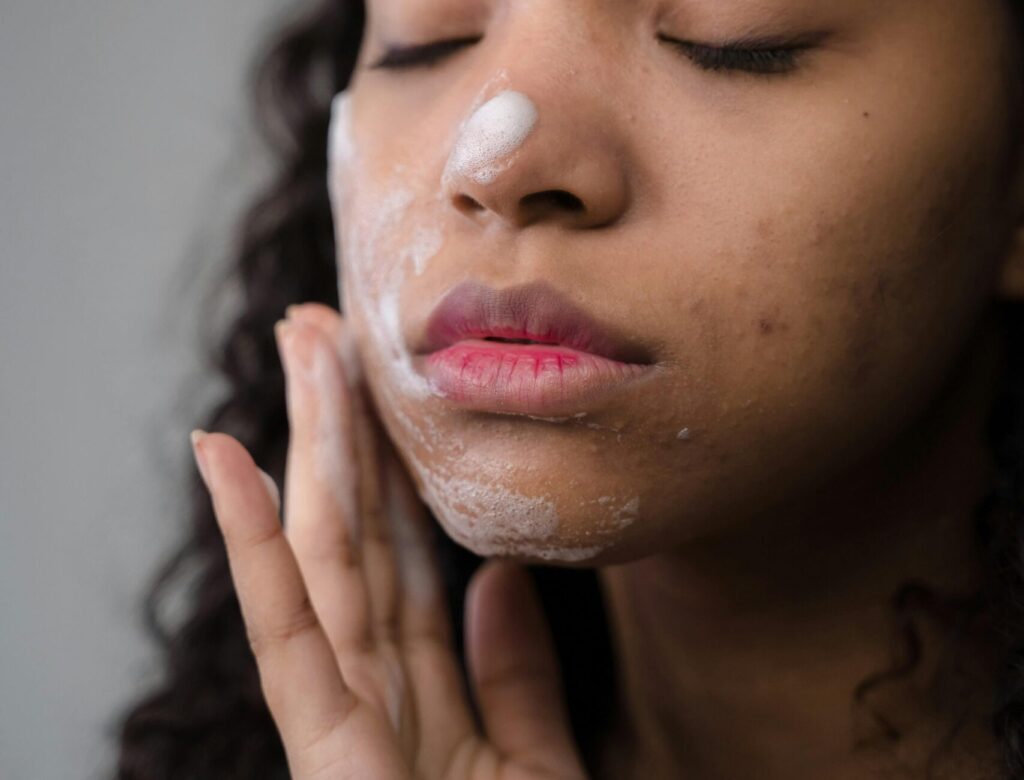
Alisha Endre had little to no major skin issues throughout her teens and twenties — only occasional hormonal breakouts and low-level battles with eczema. It wasn’t until her mid-thirties that she noticed unusual patches of lighter skin on her chin and lower cheeks.
The discoloration began as hypopigmentation, rather than the dark spots many Black women experience. At first, she tried to embrace them as family traits — perhaps her skin was developing freckles or a new highlight! — something unique to her aging process. In some ways, her initial reaction reflected society’s tendency to view Black women as eternal fountains of youth, where changes in skin texture or tone are often dismissed or celebrated as part of an unspoken narrative of ageless beauty. But as the patches on her skin grew more textured and dry, she realized they were something more serious.
One night, when she was fresh from the shower and make-up free, her partner wondered aloud, “What’s going on with your face?” That slightly abrupt question compelled Endre to seek medical help. Fatigue, joint aches, and unexpected hair shedding began to surface almost simultaneously. Alarmed, Endre turned to her primary care physician and underwent a series of blood tests. Despite a diet that included red meat and eggs, she discovered deficiencies in vitamin D, B12, and iron. This revelation only heightened her anxiety as she sought solutions to her skin issues while addressing what seemed like a growing list of health challenges. She started weekly B12 injections and high-dose vitamin D supplements, yet her skin continued to worsen.
Amid mounting concerns, she searched her symptoms online. “According to Google, I was dying,” she says with a laugh, though the fear at the time was very real. Worried about a possible autoimmune condition such as lupus, especially with a family history of lupus and sickle cell disease, Endre was anxious about the outcome. She describes the fear as overwhelming, compounded by the lack of visible role models or representation of people with skin conditions similar to hers in the media. Advanced panels came back negative for autoimmune disease, but the rash and redness only tightened their grip on her confidence.
The Diagnosis: Rosacea
Endre soon discovered she had rosacea, a chronic inflammatory skin condition characterized by redness, flushing, pustules, and bumps on the face. Redness may appear brown or purplish on melanated skin, and small blood vessels may be less visible, leading to misdiagnosis or, worse, no diagnosis at all.
Alisha Endre is no stranger to the spotlight. From center stage in a national-touring vocal group to standing in front of cameras in her communications role, she has built a career on visibility. Yet behind the lights and applause, Endre has quietly navigated a profoundly personal journey centered on her skin.
According to the American Academy of Dermatology, rosacea affects at least 14 million U.S. adults, or about 1 in every 20 individuals. Despite the growing focus on skincare and self-care, a significant gap persists in dermatology when it comes to treating rosacea in darker skin tones. That’s partly because symptoms like redness or flushing are harder to detect on melanated skin, leading to misdiagnosis or delayed treatment. While rosacea is less common in Black individuals, it does occur, and because it’s often overlooked or mistaken for other conditions, it can go undiagnosed for years.
Conversations around beauty inclusivity, mental health, and skin acceptance are becoming more widespread, but the emotional toll of rosacea remains largely under-addressed. This systemic neglect, coupled with a healthcare system that has historically overlooked the needs of people with darker skin, leaves many feeling invisible in their journey to better skin health.
The diagnostic gap isn’t new. A study published in the Journal of the American Academy of Dermatology highlights long-standing disparities in dermatological care for people of color, all rooted in a lack of diverse representation in medical texts, limited training, and exclusion from clinical research. Many dermatology textbooks still predominantly feature white skin, making it difficult for clinicians to recognize how conditions like rosacea, eczema, or psoriasis present in darker tones. “Organizations like Skin of Color Society and VisualDX are working to expand image collections to better reflect skin types, an important step forward in medical education,” says Dr. Kakpovbia, a dermatologist at NYU Langone Health.
As part of her amateur sleuthing, Endre launched an intensive skincare experiment. She sampled niacinamide serums layered in hyaluronic acid. She tried vitamin C treatments and fortified her skin with sunscreen every morning. In these early stages, her approach to skincare wasn’t just a quest for physical relief but a desperate search for answers to what had started as a confusing and isolating experience. Her skin texture improved for a while, but flare-ups returned without warning. Frustrated by the lack of answers, she sought support on social media, particularly TikTok, where others like her could commiserate.
With its vulnerability culture, TikTok became a space where Endre could process in real time, crack jokes, and share her skincare journey with others who understood. “If my story can help just one person, I am happy,” she says.
Challenges in Finding the Right Care
Throughout her struggles, a few urgent questions kept resurfacing — questions that extended far beyond her bathroom mirror. Why did she have to rely on TikTok for support instead of her dermatologist? Isn’t the medical system supposed to provide answers, not confusion? Why is rosacea still underdiagnosed in darker skin tones, and why are medical textbooks and clinical tools failing to reflect the full spectrum of skin? And who gets to be seen and treated in skincare narratives and clinical research when beauty campaigns and diagnostic images rarely include people who look like her?
In search of relief, Endre consulted three dermatologists throughout 2023. The first specialist diagnosed her with seborrheic dermatitis and prescribed a ketoconazole mask that made her face sting and burn. “My skin got angrier,” she says. The same doctor offered topical steroids next, and Endre refused, unwilling to risk severe side effects like skin thinning, sensitivity, discoloration, and rebound flare-ups. “I just knew it wasn’t the right thing for me.”
A second dermatologist reached the same conclusion and suggested mild over-the-counter products. Still, Endre’s skin resisted improvement. Finally, an esthetician referred her to a highly regarded Black dermatologist, Dr. Vallerie Callender, who diagnosed Endre with rosacea. Endre giggled softly, then whispered to herself during her visit: Rosacea? Black people don’t get rosacea. Relief and confusion washed over her in equal measure, and for the first time, her condition had a name. Instead of immediately prescribing topicals, the dermatologist spent nearly 20 minutes listening to Endre’s story.
Dr. Callender asked Endre about more than just her skin: she also inquired about her stress levels and daily diet, including whether she had a sugar fix, and about her lifestyle habits, from her face-washing frequency to her home’s water quality. As Dr. Callender gently assessed Endre’s skin during a virtual visit, she explained that while rosacea is less common in darker skin tones, it does occur and can present in ways that differ from classic cases.
Rosacea is a chronic inflammatory skin condition that typically shows up as facial redness, flushing, and acne-like bumps, says Dr.Kakpovbia. On darker skin tones, the redness may look more brown or purple, and visible blood vessels are often harder to detect, making it easier for the condition to be missed or mistaken for something else.
Psychologist Dr. Rashanta Bledman, who specializes in body image and identity, says chronic skin conditions take an emotional toll. “People struggle not just with physical symptoms, but how others and themselves perceive their skin,” she explains. The societal pressure to appear “flawless” adds to the distress, she says, particularly when the condition is visible. “There’s a constant narrative that skin should be smooth, poreless, and unblemished,” says Dr. Bledman. “But so much of what we see in the media is heavily filtered and edited. That creates unrealistic ideals, making those with skin conditions feel like outliers or even ashamed of their appearance.”
Endre experienced what Bledman refers to as “identity distress,” a state where individuals begin to feel defined by their skin. Endre recalls turning down invitations to events, meticulously curating selfies on her social media, and worrying that colleagues would focus more on her appearance than her work. Over time, she realized that her skincare troubles weren’t just superficial; they eroded her self-worth. “I’ve spoken with people who feel ashamed and self-conscious, abiding by social interactions or dating, as their conditions make them feel defined by it, leading to distress about their identity,” she says.
New tools are emerging to close diagnostic gaps. One is Ros-NET, an AI-powered diagnostic system developed by doctors at Ohio State and Wake Forest University. In a study funded by The National Rosacea Society (NRS), Ros-NET analyzed digital photos taken in natural light and accurately identified rosacea 88 to 90 percent of the time. Unlike traditional exams, which can be inconsistent and subjective, especially on darker skin, Ros-NET offers a more objective method for recognizing symptoms. Researchers are working to expand the tool’s database to include a wider range of skin tones and rosacea variants. The existing model shows several inconsistencies — it can’t pinpoint exact symptoms or lesion types, and it lacks details about where the skin is affected. Researchers noted that continued improvements to the algorithm could help fill those gaps.
Andrew Huff, president of the NRS, emphasizes the organization’s commitment to inclusive care through its research grants, educational materials for patients of color, and rigorous product evaluation. To earn the NRS’s Seal of Acceptance, each product must pass a human repeat insult patch test on at least 30 healthy volunteers and a safety-in-use trial with 30 rosacea patients, proving it won’t trigger flare-ups. Because rosacea’s underlying inflammation is the same across skin tones, these vetted products are intended to be safe and effective for everyone.
Huff states via email, “We have awarded more than $1.7 million since the program’s inception 25 years ago, and it represents an excellent opportunity for a researcher interested in exploring rosacea in underrepresented communities.”
Rebuilding Confidence and Skin Health
From a psychological standpoint, rebuilding a positive relationship with your skin takes both daily habits and a long-term mindset. Dr. Bledman emphasizes the power of consistency in skincare routines — simple steps like cleansing, moisturizing, and applying sunscreen daily. These small acts, she explains, aren’t just about appearance; they signal to your brain that you are taking care of yourself, which can naturally boost feelings of well-being.
Dr. Bledman encourages people to be mindful of how they view their skin. “Skin changes over time,” she notes. “Women of all ages should know that striving for perfection is neither realistic nor necessary.” Instead, she wants women to focus on consistency and care to help shift the narrative from chasing flawless skin to nurturing healthy skin. She recommends curating your social media feed to include people with similar skin experiences to support that shift. Creating a relatable digital space can do wonders in easing pressure and promoting a healthier self-image.
Endre’s journey was never just about clear skin. She wanted to feel like herself. And in doing so, she learned to listen to her body, address her stress, and release the need for perfection.
Within months of seeing Dr. Callender, the visible redness and bumps on Endre’s face faded. The stubborn hypopigmented patches lightened enough to blend more naturally with her complexion. Yet, Endre sensed she had not addressed the root cause entirely. After months of topical treatments, she’d reached a plateau.
In a moment of clarity, she turned inward. Gut health held the missing piece. Although she had eaten eggs daily since childhood — fried, scrambled and poached — Endre decided to eliminate them, along with pork, a protein she had previously enjoyed. The change felt spiritual.
Soon after adjusting her diet, the transformation astonished her. Those last pale spots began to vanish. Over time, she learned she could reintroduce eggs sparingly, always mindful of portion size and preparation. Alongside dietary adjustments, she installed a water filter to reduce irritants. She also adopted consistent stress-management rituals: evening walks, meditation, and stricter screen curfews. “I didn’t give up until I figured it out, and I hope others have the same drive — persevere, and you’ll get through it.”
Correction (Feb. 4, 2026): An earlier version of this story incorrectly attributed the honorific of Dr. to National Rosacea Society President Andrew Huff. The original story also incorrectly stated that rosacea afflicts around 1 in 10 adults in the U.S. The number is actually closer to 1 in 20 adults.
Related Posts

February 20, 2026
Too Many Warehouses: Industrial Expansion Meets Community Resistance in a California Town
Perris residents are pushing back against the proliferation of warehouses as city leaders impose a 10‑month hiatus on new industrial development. "How is it possible that a park is boxed by shipping containers?" asked one resident.

February 2, 2026
At 31, She Had a Heart Attack. A Decade Later, She’s Redefining Her Story
Ten years ago, Kisha Stewart was just 31 when she suddenly collapsed with crushing chest pain — what she thought was postpartum fatigue turned out to be a heart attack caused by Spontaneous Coronary Artery Dissection.