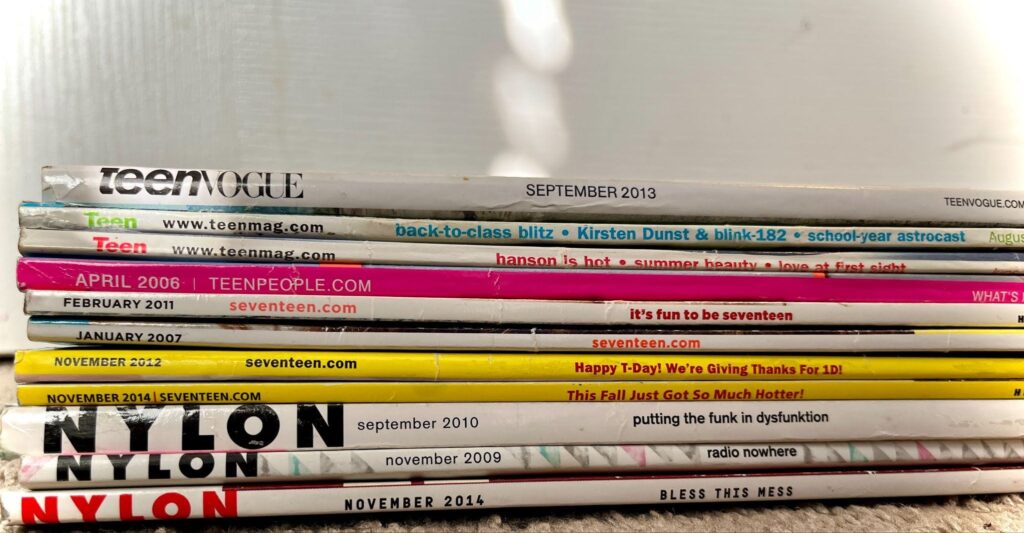
NASHVILLE, Tenn. — It’s the year 2000, and Teen magazine has released its glossy June cover: a portrait of three brothers in dark denim shirts and three marginally different shades of khaki, with beachy bronze skin and various lengths of surfer hair. The cover line says it all: “Hanson is hot!” The subtitle reads: “And guess what … they’re all single!”
The magazine is full of frosty metallic makeup tutorials, clothing ads featuring Hawaiian beach print, and millennial tech items like flip phones, pre-Apple mp3 players, underwater radios, VTech Helio Personal Digital Assistants, CD players, and Tiger e-fortune cookies in that translucent plastic everyone loved.
Thirteen years later, Teen Vogue’s 2013 Fall Fashion cover features One Direction, at their peak, in all black with moody-but-approachable expressions. Inside is an array of Brit-rock/Indie-sleaze styles with a blend of American collegiate-prep since it’s also their back-to-school issue. Both of these magazines have locked in two specific time periods of teen girl aesthetics — the Y2K capri-pants, butterfly clips, platform flip-flop-wearing girl and her younger iteration: the Tumblr-obsessed, leather-jacket-toting, Jessica Day blunt bangs, combat boot effortless cool girl.
The End of the Newsstand Era
Now, try searching for the present-day version of that cool girl in magazines. You won’t find her. Books and magazine shelves at big-box retailers like Target feature the latest manga collections and trendy smut novels prominent on TikTok. But the days of stopping by the news rack and grabbing a Seventeen magazine are long behind us. The latest generation of cool teen girls is now fully digital and predominantly on TikTok, following influencers, or getting their latest inspo from their Substack feeds, the successors of Instagram and Tumblr.
Over the course of two decades, the teen magazine has quietly disappeared, replaced with digital imitators. One by one, the anchor publications of girlhood disappeared from newsstands. CosmoGirl! folded in 2008. Teen People ended its print run two years earlier. Elle Girl shut down its U.S. edition. Seventeen reduced its print presence to a handful of special issues before going mostly digital. Rookie, the teen magazine built by a teen, shut down in 2018. By the late 2010s, Teen Vogue had also gone digital-only, later folded deeper into the larger Vogue brand in 2025.
With each closure, a little more of the teen editorial ecosystem dissolved, especially the spaces that centered on marginalized girls. For a good chunk of the 2010s, a handful of teen publications did the quiet work of platforming Black, brown, queer, and off-center voices. And, when those last publications vanished, those pathways narrowed, too.
As Girls United pointed out in a 2024 article, teen girls now share the same hypercharged digital feeds as adults — the beauty standards, the consumer trends, the pressure to grow up fast. Without teen-specific media to filter any of it, the line between adolescence and adulthood has blurred.
A few teens are resisting the noise, choosing substance over aesthetics, but they’re doing it without the editorial helping hand that once existed. When that distinction collapses, we lose something subtle but important: the protected stretch of time where teens could be teens. No pressure to brand themselves. No expectation of aesthetic perfection. No adult-sized scrutiny.
So, why the collapse?
The reasons stack neatly: audiences aged out, advertisers shifted their dollars to funding influencer marketing that targets teen girls, and the teens themselves migrated to their phones, particularly during the early Covid years, when online spaces became a lifeline to their social circles.
The collapse of teen media isn’t just about a changing of the guard brought about by technology, though. It reflects a deeper shift in how young people consume media and build their identities, and where they seek community. In the widespread absence of seasoned editors and glossy gatekeepers, algorithms, influencers, and fandoms have rushed in to fill the gaps.
At the same time, multiple studies, expert analyses, and simple observation suggest that teens don’t trust traditional media, and many of them rely on artificial intelligence to guide them through life, which impacts not only their literacy rates but also their role as the future adults of the world.
High school students themselves are sounding an alarm: as one California high school publication put it after surveying their classmates, America may be in the midst of a “reading recession,” with fewer teens picking up books and glossy publications alike. At the same time, a 2023 Pew report shows social media dominating where young people spend their attention, not just for entertainment, but for ideas and identity. TikTok and YouTube are the go-to for young girls. They’re constantly accessing those apps, with little desire to stop, regardless of whether the content is appropriate or not.
According to a News Literacy Project report published in November 2025, 89% of teens are dismissive of news media, 67% of the teens they surveyed have little concern at the decline of news organizations in the U.S. over the last 20 years, and 80% believe “that journalists fail to produce information that is more impartial than other content creators online,” while also not fully understanding how newsrooms or independent journalists operate.
The academic landscape is unhelpful in addressing this growing distrust, especially as news literacy is rarely taught. Many high school and college students are using AI tools for coursework, daily tasks, and as an alternative search engine during research.
What’s left is a generation that has unlimited access to information but limited trust in the people who produce it; there are also far fewer curated, youth-centered spaces designed to help them sort any of it out. The disappearance of teen magazines has both cleared out the newsstands and created a vacuum in authority, guidance, and editorial voice at the exact moment teens are navigating the most chaotic information landscape in modern history.
The “Teenager” Becomes a Consumer
To understand why teens once gravitated to magazines littered with stock photos of their idols, go back to the September 1944 debut of Seventeen. Around the same time, the word “teen-ager” (initially stylized with a dash) was formally introduced during World War II-era advertising to create a new distinct consumer. Post-war, the term took on more meaning for this new subgroup who were neither adolescents nor adults, and with more leisure time and money to throw around. Towards the end of the war, more teenagers had stopped working full-time jobs and high school enrollment surged from 11% of 14 to 17-year-olds in 1900 (about 630,000 students) to nearly 80% by 1940, a jump to more than seven million, according to Kelly Shrum; this younger generation of Americans increasingly depended on the opinions of peers and needed to see themselves reflected in media and entertainment.
Shrum, author of Some Wore Bobby Sox: The Emergence of Teenage Girls’ Culture, 1920–1945 and “Teena Means Business: Teenage Girls’ Culture and Seventeen Magazine, 1944–1950’” in Delinquents and Debutantes, notes that Seventeen hit newsstands after a pair of teen girl-specific columns in a 1941 issue of Parents Magazine and even earlier columns in American Girl and Everygirls — both tied to Girl Scouts and Camp Fire Girls — laid some groundwork, but Seventeen was the first publication to imagine teen girls as a full cultural demographic.
By the end of the decade, it was selling more than two-and-a-half million copies to a predominantly white, suburban, middle-to-upper-class readership. Like the modern version, its early issues were packed with beauty tips, fashion advice, and dating columns. But Helen Valentine’s vision also included articles on war, consumerism, atomic energy, higher education, and voting — topics that some readers embraced, while others openly pushed back.
The letters section became its own battleground. One frustrated reader wrote, “Why, oh why, must you print articles on world affairs in a magazine that a girl looks to for advice on clothes, charm and personality?” Another complained, “Stories like those on atomic energy are very boring. I think you should have more articles on dates and shyness.”
The editors didn’t shy away from responding. “If enough world citizens are similarly bored by atomic energy, we fear that teen-agers may find themselves with no dates left to worry about,” they quipped in 1946.
Other girls defended the magazine’s ambition. “Although I am thirteen, I feel that I am not too young to think seriously about the part I am to play in the great postwar world,” wrote one reader. Another argued, “Seven out of ten teen-age girls don’t know half as much as they should about world affairs. Seventeen can and must create a teen-age interest.”
The same push-and-pull played out in conversations around dating and sexuality. Beginning in 1945, Seventeen launched an annual “Boy Meets Girl” issue, dispensing advice on conversation, romance, and how to attract boys while sternly discouraging necking, going steady, or early marriage.
Teen girls, unsurprisingly, didn’t always agree. One wrote, “In the gang I go with, the boys are really swell. At least I thought so until I read your article. We are actually wicked enough to believe in necking. And, hold your hat, I really enjoy it!”
The editors printed the dissent but maintained their moral line. Together, these letters show Seventeen as more than just an advertiser trap; it was creating, debating, and refining the cultural script for what teen girlhood was supposed to be.
From the beginning, teen magazines were built on the belief that girls deserved to be taken seriously. Seventeen’s first editor-in-chief, Helen Valentine, imagined a publication that treated teenage girls as multifaceted human beings, i.e., people with emotional and intellectual needs, with curiosity about both the world and themselves. Her vision blended “boys and books, clothes and current events, cooking and careers,” and Seventeen delivered on it: alongside lipstick tips and fashion spreads, early issues recommended books on inflation and atomic energy, ran pieces on world affairs, and encouraged girls to become active, questioning citizens.
That ethos didn’t disappear with time. Decades later, when Lindsay Peoples, current editor-in-chief of New York Magazine’s women’s interest publication The Cut, stepped into Teen Vogue at 28, she found herself drawn to the same core idea Valentine championed in 1944.
“I wanted Teen Vogue to be a place where young people could ask questions or talk through the things they really cared about,” Peoples told me over the phone. For her, separating style from politics never made sense when both shape how teens understand themselves and their place in the world. “There was no need to pretend young people can’t handle these topics,” she said. “I just never believed that to be true.”
By the late 1990s, female-focused teen magazines were a staple in the culture that is the American teen zeitgeist. Women’s magazines had so-called little sister teen editions like CosmoGirl!, Teen People, Elle Girl, and Teen Vogue — most sticking to their own unique formats, but removing the adult topics. For so many millennial girls, Teen Vogue wasn’t just a magazine, but also an entry point for imagining a future career within various industries like journalism, fashion and styling, branding, and photography.
Peoples was one of them. She grew up glued to MTV’s gauche reality show The Hills, watching Lauren Conrad and Whitney Port navigate Teen Vogue’s fictionalized fashion closet with wide-eyed awe. “The Hills is not real life,” Peoples said with a laugh. “But it opened the door for me, at least mentally, to see that there were possibilities to have a career in fashion.”
In college, when a professor asked what really excited her, the only honest answer she had was what she was seeing on television. She didn’t apply for the internship herself — she thought she wasn’t experienced enough — so her professor sent in the application for her. Teen Vogue took her anyway. She ran errands, worked the closet, fell in love with the chaos, and kept every issue she touched. That internship didn’t just give her experience. Peoples emphasizes that “it really obviously changed the trajectory of things for me.”
The Henry J. Kaiser Family Foundation conducted a Fall 2004 study titled “Tweens, Teens, and Magazines,” which found that teen readers turned to magazines as a valuable source of information and advice for their personal lives. The study also found that “teen readers want the content in their magazines to reflect their lives, and they rely on magazines as a sounding board, fashion and beauty consultant, and close confidant.” The research concluded that most teens looked to magazines just as much as they did their friends when it came to trends, and magazines were the go-to source for most non-fiction reading.
Surprisingly, there was never a Seventeen or Teen Vogue equivalent for teen boys. What they got instead were niche interest magazines for sports, gaming, science, music, and comics. The attempts to create boy-focused spin-offs, like MH-18 from Men’s Health, Nylon Guys from Nylon, or Blaze from Vibe, never lasted. The idea of a magazine that helped boys navigate identity, friendship, style, or adolescence simply never existed at scale. Teen magazines were, in almost every era, a space built for girls.
What surprises me isn’t that these magazines didn’t exist, but rather what the gap reveals about gender and readership. Teen girl magazines assumed girls were readers who sought guidance, voice, and identity-building. Teen boy media assumed that boys didn’t need (or wouldn’t want) any of that. Girls were encouraged to read themselves into adulthood; boys were nudged toward activities instead of reflection.
Who Was Centered and Who Wasn’t
For Black teens, the disappearance of these teen spaces carried a particular weight. Publications like Right On! and BlackBeat — launched by the Laufer Company in 1971 and 1983, respectively — had long created their own editorial ecosystems, centering Black music, style, and everyday teenage life well before representation became a digital talking point. Unlike the sporadic visibility found in mainstream teen magazines, these outlets treated Black girls as the core audience, not the exception.
That familiarity often started at home. Many Black households kept JET and Ebony on the coffee table, always within reach for family and guests. “I thought it was something everybody did,” says Timmaya Gill, 33, whose mother and grandmother normalized having Black publications front and center in their homes.
Flipping through those issues sparked her love for browsing the magazine aisle as a teen, even if the general drugstore selection rarely showed anyone who looked like her. She pieced her style together anyway, blending the notable updos of the time like pompadour ponytails, business casual empire waist dresses, and the metallic-y makeup tutorials she found in those pages with what she saw on TV — Raven-Symoné’s eccentric Disney Channel looks, in particular.
Decades later, Gill’s 11-year-old daughter Alana is experiencing a media landscape that looks nothing like the one her mother grew up navigating. Instead of flipping through magazines, she watches YouTube challenge videos (like DudePerfect or eye-catching colorful videos where other kids are baking cakes for the first time), spends time on Roblox, and pulls her style cues from the wide-leg jeans, Nike Panda Dunks, and whatever trendy items the algorithm serves next. Gill gets most of her own beauty and style recommendations from influencers like De’arra Taylor and Olandria Carthen.
What used to be a shared cultural script between generations has splintered into individualized feeds — each one tailored by an algorithm that learns a child’s preferences faster than their parents can. Gill realized this in real time during our conversation, when Alana casually mentioned she prefers plain tops to graphic tees. Her mom laughed in disbelief. “She’s never told me that,” Gill said.
Despite that generational shift at home, Gill and her daughter are part of the unraveling of trust in traditional media altogether, driven by distance. Pew Research found that the portion of Americans who say they follow the news “all or most of the time” has dropped dramatically, from 51% in 2016 to just 38% in 2022.
At the same time, longtime news outlets aren’t just losing attention — their audiences are shrinking across formats: print subscribers are falling, digital traffic is down, and local newspapers are hemorrhaging readers. This collapse is part of an industry-wide retreat: publishers are scaling back, trust is eroding, and the publication of teen-centered editorial spaces seems like less of a priority in a media ecosystem marked by audience flight.
An Unmoderated Landscape
According to a News Literacy Project report published in November 2025, 89% of teens are dismissive of news media, 67% of the teens they surveyed have little concern at the decline of news organizations in the U.S. over the last 20 years, and 80% believe “that journalists fail to produce information that is more impartial than other content creators online,” while also not fully understanding how newsrooms or independent journalists operate.
If teen magazines once acted as mediators — offering curated access to celebrities and structured stories about girlhood — today’s teens move through a landscape with no editorial filter at all. Instead, they get whatever the algorithm hands them: livestreams, vlogs, confessions, breakdowns, and everything in between. It’s easy to assume that parasocial relationships are a consequence of this shift — that teens only feel this close to influencers because they stopped reading magazines.
But Dr. Claire Sisco King, a media studies scholar at Vanderbilt, pushes back on that timeline. Parasocial relationships, she explains, have always been part of celebrity culture. “The key is the para,” she says. “It means beside, alongside. These relationships run parallel to a public persona. They’re not reciprocal in a traditional sense, but they carry a lot of meaning for the people who engage in them.”
What’s changed isn’t the existence of parasociality — it’s the infrastructure around it. Teen magazines once regulated that intimacy. They chose the photos, the quotes, the angles. They decided how close a teen reader could get. Early fan publications literally invented movie stardom by building consistent personas across issues and eras, and teen magazines inherited that tradition, offering a carefully framed version of closeness meant for young readers.
Now, that editorial layer is gone. Instead of a monthly interview, teens get daily — sometimes hourly — access to influencers and micro-celebrities who build entire careers on unfiltered availability. The distance that once defined celebrity, what made a “star” feel far away, has been replaced by constant presence. As King puts it, “We’re swimming in celebrity or pseudo-celebrity culture.”
That shift matters for teenagers because adolescence is a period of intense identity formation. Teens aren’t more gullible — they’re simply more affected by the media they’re exposed to while their brains are still developing. Imitation is a component of being human. It’s not new. What’s changed is who teens are encouraged to imitate and what values dominate the spaces where they spend their time.
If magazines once offered curated models, today’s teens navigate an unmoderated landscape where intimacy is manufactured for engagement and aspirational identities often skew toward whiteness, thinness, and wealth. Parasociality didn’t emerge because teens stopped reading. It intensified because the infrastructures that once shaped teen culture fell away, leaving a vacuum that platforms were more than ready to fill.
No More Glossy Pages
By the mid-2010s, the shift was already underway. As pop stars livestreamed from dressing rooms and influencers invited viewers into their bedrooms, teen girls didn’t so much abandon magazines — social media simply outpaced them. Print couldn’t compete with immediacy, access, or the promise of being seen.
But here’s what got lost in the migration: the idea that girlhood could be a shared experience, not just a personalized one. Teen magazines weren’t perfect — far from it — but they created a kind of scaffold. A timeline. A sense that there were others out there navigating the same confusion, the same longing, the same stupid questions about whether necking was worth the scandal.
Now, every teen gets her own feed. Her own influencers. Her own algorithm that learns her insecurities faster than she does. Girlhood has become something you optimize, not something you grow through. And without editors and gatekeepers, without anyone asking, “Is this actually good for you?” the pressure to perform a polished, prepackaged version of yourself starts earlier and ends, well, never.
The teen reader didn’t really vanish. She’s everywhere now — on TikTok, on Substack, in the comments. But the structures that once held space for her to figure out who she was have dispersed. And no one’s built anything to replace them yet.
Related Posts
October 10, 2026
Analog Art in the Digital Age
Amber Lauder is a photographer who has embraced the analog aspects of her craft in an effort to stay connected with the world around her.
October 9, 2026
Chef Arwa Lootah is Putting Emirati Cuisine on the Map
For hundreds of years, Emirati cuisine has rarely been documented or written down. Now, Emirati chef Arwa Lootah is reimagining the nation’s food for a new generation.