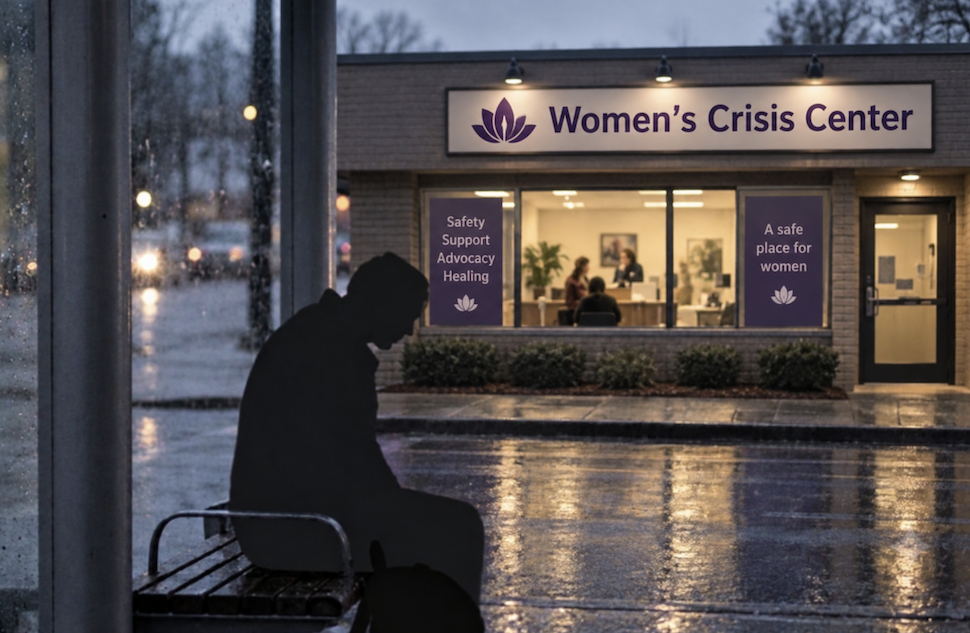
(SALERNO, Italy) — Alfonso Veneziano picked up his six-year-old daughter from elementary school one day in January 2024, as he had many times before. Holding his child’s hand in one hand and her backpack in the other, he listened to her talk about her day. Everything was ordinary, he said, until his ex-wife spotted the pair and ran toward them.
“She yanked me,” he said, explaining how his ex-wife forcefully pulled on the backpack he was carrying and caused him to fall.
Veneziano recorded the aggression with his smartphone. In the video, which The Click viewed, his daughter cries out.
Veneziano has impaired balance due to the use of a prosthetic leg, worn since losing his left leg in a car accident as a teenager. The force of the assault was enough to make him fall, sending him to the hospital and putting him in a wheelchair with a three-month-long recovery, according to medical records The Click reviewed.
“The doctor doesn’t know if the damage is reversible,” he said.
Veneziano’s ex-wife’s name has been withheld in accordance with Italian law. Her lawyer did not return calls seeking comment. Court records from criminal and civil proceedings corroborate Veneziano’s account. The Click reached out to the woman’s attorney for comment but received no response. Given that the proceedings are ongoing, and in accordance with Italian journalistic and ethical considerations, The Click did not contact Veneziano’s ex-wife directly.
Veneziano is among hundreds of Italian men who are victims of domestic abuse. Italy does not collect public data on the percentage of domestic violence cases with a male victim. However, recent government reports in the US and the UK suggest that men are victims of domestic violence in 25-40% of reported incidents.
Italy does not distribute assistance to men from its primary anti-violence centers. The few centers that do offer help are ineligible for public funding. To escape abusive relationships, men must rely on their own savings to obtain psychological and legal support.
This is in sharp contrast to services provided to women victims of violence within and outside of the family. In Italy, female victims can receive assistance from more than 400 anti-violence centers, and the Italian National Institute of Statistics (ISTAT) regularly dedicates resources to major surveys to track these victims.
Italy’s Minister for the Family, Birth Rate, and Equal Opportunities Eugenia Roccella argued that violence against women is a specific form of gender-based violence that requires targeted policies. There are no targeted policies for male victims.
Italy’s Minister of Justice Carlo Nordio sparked controversy at the same conference by describing male dominance as almost genetic, his remarks framing domestic violence as solely a women’s issue.
The difference in how the two genders are perceived became clear at the end of 2025, when the Italian Parliament formally added a new offense to the penal code: “femminicidio,” or femicide, the killing of a woman because she is a woman. The crime is punishable by life imprisonment. In contrast, voluntary homicide of a man (or woman, not based on gender )is punishable by 21 years in prison in Italy, although aggravating circumstances can lead to life imprisonment.
![Roccella and Nordio [photo credit: il Sole 24 ORE]](https://theclick.news/wp-content/uploads/2026/08/Screenshot-2026-08-27-at-19.23.20-300x145.png)
Italian ministers Roccella and Nordio have addressed gender-based violence in different ways, sometimes sparking controversy. [Credit: il Sole 24 ORE]
Veronica Coppola, attorney and president of Ankyra, an anti-violence center that provides support to men and women, argues that the Italian social framework and culture do not encourage male victims to seek help, and men often feel ashamed of being abused.
It is precisely this sense of shame that Veneziano said prevented him from seeking help in the first place.
Veneziano said physical and emotional abuse was always part of his experience as a husband, having endured denigration, mockery, and psychological abuse. He recalls an episode when he had boils on his leg and could not wear the prosthesis or go out. He said his then-wife complained and made him feel guilty. He also described sporadic episodes of physical violence in which she “pushed and shoved” him.
His wife’s attorney, who, in the legal documents, defined her client as “cooperative and distressed by the accusations leveled against her,” did not respond to The Click’s request for comment.
Despite the incidents, divorce was never an option, Veneziano said. “I deeply believe in marriage.” He had witnessed the bond between his parents and recalls that when his mother became a widow at 35, she never looked for another man. “She used to say. ‘How could I start over, since I still love your dad?'”
In 2022, Veneziano alleged that his wife was cheating on him. He said the affair began three months after their wedding and lasted for almost seven years, until he discovered her text messages. For his daughter’s sake, he decided to forgive the betrayal. But a few months later, he learned of another alleged affair. Veneziano said that when he confronted his wife, her attitude shifted from “thanks for your forgiveness” to “you must leave this house.” He moved out, while his ex-wife remained in their home with their child.
In October 2022, what he calls the hardest part of his life began. It was a period marked by accusations of violence by both sides, battles in court, and a fight for his daughter. The charges against Veneziano were dismissed. The other proceedings are ongoing.
Fighting to see his child again
Violence has many faces, according to professor Michele Miccoli, attorney and co-author of a book about violence against men, “Codice Rosso: Quando l’uomo è vittima” (Red Code: When the man is a victim). Psychological abuse is common but difficult to detect, he said, especially during a divorce and when children are involved. “Children become a weapon,” he said, “and men are scared to lose them.” Obtaining custody for fathers is always difficult. Sometimes, even staying part of their children’s lives becomes a challenge.
“Every morning, I stood outside my baby’s kindergarten. I didn’t know if she was there, if she was okay,” Veneziano said, recalling the time his ex-wife allegedly prevented him from seeing their daughter. The reasons were financial, he said, his voice heavy with emotion. When he moved out of their home, although there had not been a trial yet and no judge had ruled on maintenance, he started giving his wife 400 euros a month. When his ex-wife asked for more money and he refused, she stopped him from seeing their child. “It was blackmail.” Veneziano did not see his daughter from December 2022 to March 2023, when the judge ruled that he must be allowed to see her.
Attorney Martina Garassini, co-author of Miccoli’s book, described defending a man like “an uphill battle.” In many courts, there is a strong maternal preference, even when it is clear that the mother is not a good parent, she said.
Legal custody is a complicated matter. Veneziano did not seek sole custody since his ex-wife was not violent with their child, and he believes that growing up with a mother is important.
“I want my daughter to have both parents,” he said, “I hope she feels that her life is normal.”
Back in 2023, all he wanted was to see his child. When they finally met again, in March, his daughter, who was four years old, struggled to recognize him. She thought her uncle was her father. Veneziano said, “I had to explain to her who I was.”
The judge allowed him to see her a few days a week. He asked for a part-time position so he could spend more time with her. It took months for his daughter to call him “Dad” again.
![Fulvia Siano [photo credit: Siano]](https://theclick.news/wp-content/uploads/2026/08/Screenshot-2026-08-27-at-19.18.59-219x300.png)
Fulvia Siano appealed unsuccessfully to the Italian Parliament for access to public funds for Perseo, the organization she leads that serves both men and women.[Credit: Fulvia Siano]
He wonders what would have happened if the roles had been reversed and his ex-wife had ended up in the hospital. He believes he would have never seen his daughter again, and maybe he would have ended up in prison. Veneziano said it is harder for a man to be seen as a victim, since “there is no equality in this country.”
Who’s going to help you?
Veneziano spent three months in a wheelchair because of the injury his ex-wife left him with and could not see his daughter because, in that condition, he was unable to care for a child.
He ultimately decided to call the government-funded anti-violence hotline, 1522, to talk about what had happened and seek support. The reply he received was unexpected. “They mocked me because I was a man,” he said.
After that, he sent emails to politicians, from local representatives to ministers. No one replied. Veneziano kept searching for help online, but all the anti-violence centers he found stated explicitly, “for female victims.”
In Italy, there are 409 anti-violence centers for women, staffed by doctors, psychologists, and attorneys. Their services are provided free of charge, as the state funds them. Eligibility for state and regional funding is subject to a specific condition. There is no equivalent for men.
Under a 2022 agreement on minimum standards for anti-violence centers and shelters, only centers serving exclusively “women victims of male violence” qualify for a share of the €55 million (approximately $55million) in annual public funding.
Centers that provide support to men, or to victims of female violence, are not eligible for this type of funding. Their survival depends on pro bono work, private donations, and the 5×1000, a provision in the Italian tax system that allows taxpayers to allocate 0.5% of their income tax to a nonprofit organization. According to the presidents of three gender-neutral anti-violence centers, Perseo, Ankyra, and Mi Diras Nur, the reason there are so few centers serving both genders is economic, and the lack of centers is why men like Veneziano struggle to find support.
The agreement appears to contradict Article 3 of the Italian Constitution, which states: “All citizens have equal social dignity and are equal before the law, without distinction of sex, race, language, religion, political opinions, or personal and social conditions.” However, equality does not forbid different treatment when it addresses disadvantage. Because women are disproportionately affected by violence, the Constitution allows measures specifically supporting them.
Miccoli said the country tends to view women as victims and men as perpetrators because “they are physically stronger.” It is a socio-cultural dynamic. In many cases, male victims are disbelieved and ridiculed.
According to Garassini, this dynamic makes the phenomenon of violence against men even more invisible. She explains that male victims often do not even know what to do or where to go to receive support.
After searching for help without success, Veneziano found Perseo. “I sent a message, and they called me back. I was in tears,’ he said.
Founded in 2019, Perseo is an anti-violence center “open to anyone,” according to their website. Since then, the center has supported many victims. According to the data they shared with The Click, between January and February 2025, it received 66 calls for help. During the same period this year, the number rose to 112.
The first person Veneziano spoke to was Massimo Santarelli, himself a survivor of domestic violence who ended up in the ER seven times because of the abuse he suffered at home. When his story unfolded in 2016, Perseo did not yet exist.
Santarelli knows what it means not to receive help; that is why he decided to volunteer at the center. “I try to make sense of what I’ve been through,” he explained, adding: “I do this for myself and my sons, hoping to help other fathers and children who are living what I lived.”
He recommended Veneziano to a psychologist, whose services he had to pay for himself. The man is moved to tears as he speaks about his psychological journey.
“I was ashamed of crying. Of having been cheated on. Of having been beaten by a woman,” he said, but thanks to the psychologist, he “found the courage to report the violence.”
Until that moment, he had never considered reporting the abuse because of his daughter; he feared one day she would ask him, “Why have you done that to my mum?”
After he reported the assault in 2024, the Red Code was activated. The term Red Code refers to Law N.69 of 19 July 2019, which introduced fast-track procedures and strict timelines for investigations and proceedings concerning domestic and gender-based violence.
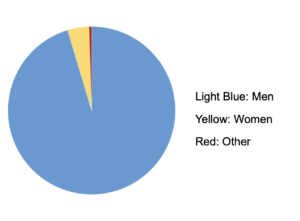
Gender distribution of people who seek help from Perseo. [Source: Perseo]
Veneziano filed his report, detailing everything from the assault to the obstacles preventing him from seeing his daughter at the beginning of the separation. He has carefully archived every single document: his formal complaints, his medical records, and the judge’s ruling. He believed he obtained justice thanks to his disability: “If I had had both legs, no one would have believed that a woman had hurt me.”
The criminal case against his ex-wife was opened, and Veneziano appointed Pasquale Pontarelli again as his attorney.
Veneziano said his ex-wife quickly filed a counterclaim: “She comes up with the allegation that, during our marriage, I had raped and beaten her,” he explained. “She suddenly remembered having been abused,” he added. The Red Code was activated again, with the woman as the victim.
The accusation was quickly dismissed. Pontarelli explained it was not difficult to prove that Veneziano had never been violent. On the other hand, his ex-wife continued to behave aggressively. The attorney said that even in court, she sometimes yelled at Veneziano to shut up.
Even if he was declared innocent, thanks to that allegation, the woman was able to go to an anti-violence center and receive free support.
The story is not dissimilar to Santarelli’s. He said that he, too, after reporting the violence he had suffered, was accused of rape. His wife, too, received assistance from an anti-violence center, while he had to cover all his legal expenses himself.
And in that case as well, the accusations were dismissed. According to Miccoli, it is not rare that false accusations are made to receive advantages, “unfortunately, [lying] is in human nature.”
Inside gender-neutral anti-violence centers
Advocating for men is a challenge, but Perseo continues its work. The anti-violence center’s president is Fulvia Siano, a clinical and forensic psychologist. She described the people who seek the center’s help as “completely invisible.”
Recalling survivors who had been turned away from every other center, Siano said that many cases are overlooked. She recounted the story of a disabled woman abused by other women; the victim was not helped by conventional anti-violence centers since she did not fit the criterion of “violence perpetuated by men.” Siano also described the case of a man abused by another man; he was unable to receive support from the main organizations because he was not a “female victim.”
“If you are in a homosexual relationship or if your mother beats you, you can’t access public funds.”
Many of the cases treated in her center involve male victims of violence perpetrated by women. According to her, most of them are fathers, victims of psychological violence. That kind of violence is harder to prove, but is no less worthy of attention, she said. Trying to change the narrative, Perseo keeps track of every request it receives.
In 2025, 481 people sought help from the center, more than 95% of whom were men. Marco David, Perseo’s manager, said the center is staffed entirely by volunteers. Even if the centers are sometimes not able to help victims because of a lack of funds, he said that volunteers keep believing in their “mission.”
Ankyra as well keeps records of everyone who seeks its support. It uses its data for research purposes. From 2014 to 2025, it assisted roughly 1,000 people, more than 80% of whom were heterosexual men. According to the center, nearly 90% of children in these relationships are witnesses to the violence against their fathers.
Coppola and her team give a questionnaire to all the people who come to their center to investigate violence, ranging from psychological to physical abuse; the purpose is to help the victim become aware of the situation. “Sometimes they ask us, ‘Am I really a victim?’ Sometimes they simply leave and come back home,” Coppola said. She explained that in abusive relationships, there are “honeymoon phases,” during which conditions temporarily improve and victims may convince themselves that the violence is over.
Because of the lack of funding, these centers can provide only minimal support. Legal proceedings are expensive, and many people cannot afford them. “Many fathers cannot fight because they don’t have enough money, and Italy doesn’t support them,” Veneziano, whose expenses amounted to 91,000 euros, said, “I had to use all my savings in a battle my country should have helped me face.”
In an attempt to improve the situation, Siano appealed to the Italian Parliament and asked for access to public grants. Her request was refused. She did not receive a reason, but she had her suspicions: “Large anti-violence centers receive millions of euros. It’s a monopolization.” She decided to write a book about violence beyond gender to raise awareness of the problem. She chose not to include all of her ideas in the manuscript because she knows they may attract even more hate than she has already received. She said that in August 2024, a colleague of hers, Simona Adelaide Martini, filed a formal complaint to the professional board against Siano, alleging incitement to violence. The complaint has since been dismissed.
Siano had also received anonymous death threats like the one below. She found it on her car.
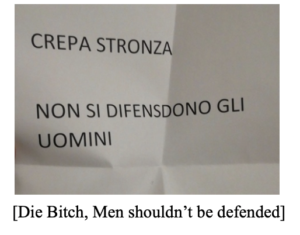
One of the death threats Siano received
“Fear doesn’t belong to me, [as a victim of violence myself] I know what it means to be scared,” Siano said, “I need to keep fighting. A fair fight, for everyone.”
Where change starts
Siano strongly believes in her mission and continues working to make the struggles of male victims visible. Recently, she launched a new project with Khadija Cirafici, founder of Mi Diras Nur, which in Esperanto, it means ‘enough, a small anti-violence center that operates mostly online. Their venture, called Rete Oltre al Genere (Network beyond Gender), aims to bring together gender-neutral anti-violence centers and raise awareness of their existence. They also plan to establish a hotline open to everyone.
![Khadija Cirafici [photo credit: Cirafici]](https://theclick.news/wp-content/uploads/2026/08/Screenshot-2026-08-27-at-19.20.57-275x300.png)
With Siano, Khadija Cirafici launched a small anti-violence center that operates mostly online. [Credit: Cirafici]
For years, each month, he had to pay his ex-wife 350 euros (150 euros for his daughter and 200 euros for the unemployed woman). In April 2026, the judge ruled that he did not have to pay anymore. With the civil case closed, Veneziano has initiated two lawsuits: one against his ex-wife for physical aggression and preventing contact with their daughter, and a second against one of her attorneys.
Veneziano has sued his ex-wife’s civil attorney, Marina Garofano, for defamation. The suit claims she portrayed Veneziano as violent in the legal documents she drafted, although he had been cleared of all charges. Veneziano’s attorney Pontarelli argues that this behavior is unacceptable, “both for moral reasons and because it violates due process: You are trying to mislead the judge with inaccurate information,” he said. Garofano did not respond to a request for comment.
Veneziano is still working part-time to spend as much time as possible with his daughter and has rented a one-room apartment near her school.
Despite everything he has been through and all the ongoing legal proceedings, he does not regret anything. He believes it was all necessary to remain part of his daughter’s life. “She is the love of my life.”
Related Posts

September 10, 2026
Simon and Fannie’s Story: A Tablecloth, a Family Mystery, and Me
I knew that my great-grandfather and his younger brother immigrated from Poland to the U.S. in 1922 when they were only 19 and 17. I did not know the tragic story of the family who were supposed to come with them until I found a photo behind a picture frame.

August 28, 2026
Michael Carrino Is Enjoying His Second Act
The Akron-based actor spent the past decade building his career in theater, film, and television. Now, he’s taking on his biggest role yet as Dr. Francis Sweeney in “Kingsbury Run.”