(CLEVELAND, Ohio) — In September 1934, along the shores of Lake Erie, a man found the remains of a woman in her mid-30s. Her body, consisting of only a torso and legs cut off at the knees, was covered in a chemical preservative that left her skin red and leathery.
Authorities wouldn’t connect her case to Cleveland’s Torso Murders for another two years. The woman —who came to be known as the Lady of the Lake — would later become Victim Zero.
Her case was first of 13 brutal murders in just four years. All of the victims were decapitated, with most still alive when it happened. Not all of them were women, and not all were white as the Lady of the Lake was. Despite years of investigation, the murders were never solved.
The Torso Murders investigation unfolded during a time of profound change in the city.
By the 1930s, Cleveland had transformed into a major industrial hub as its population and economy continued to grow. During the first half of the 20th century, its metropolitan area grew to more than 1 million residents, making Cleveland the nation’s fifth-largest city.
Immigrants accounted for 40% of the city’s population, many of whom came from Eastern Europe to escape persecution. At the same time, rural Black families moved north to cities like Cleveland during the Great Migration.
After the stock market crash in 1929, economic prosperity began to crumble. Eventually, one-third of the city’s workforce was unemployed, with homelessness and crime on the rise.
When the Lady of the Lake was discovered in Lake Erie in 1934, Cleveland was already facing the social and economic upheaval of the Great Depression.
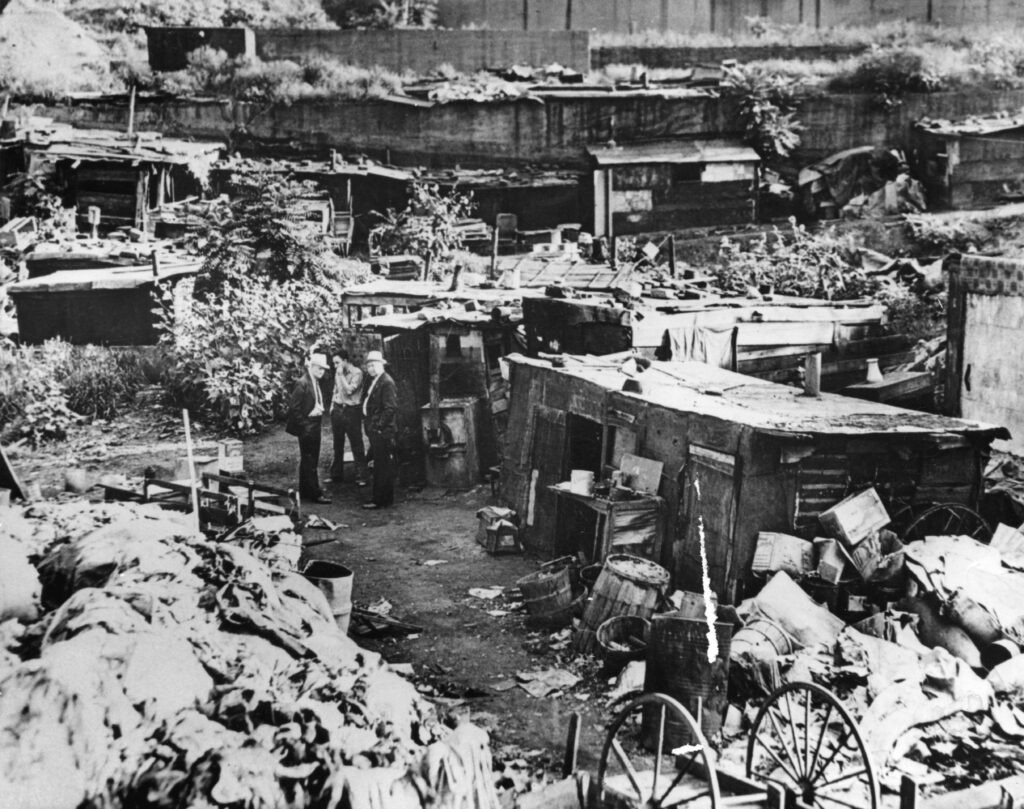
Kingsbury Run, where many of the victims were found, stretched from the Flats to East 90th Street between Woodland Avenue and Broadway Avenue. Train and rapid transit tracks cut through the impoverished neighborhood known as the “Hobo Jungle,” which was home to mostly transients who often used the railways to escape Cleveland’s brutal winters.
According to the Cleveland Police Museum, Kingsbury Run residents were often missing or unaccounted for, making it difficult to identify victims.
Cleveland police detectives Peter Merylo and Martin Zelewski worked on the case full time, often disguising themselves as locals.
The year that the Lady of the Lake was found, Eliot Ness — one of the famed Untouchables who helped bring down Al Capone — was transferred to Cleveland to tackle police corruption and organized crime as the city’s safety director. However, as pressure mounted to solve the murders, Mayor Harold Burton reassigned Ness to the case.
Later that year, Ness arrived in Cleveland and was assigned to the Torso Murders investigation alongside lead detective Merylo.
Meanwhile, Cuyahoga County Coroner A.J. Pearse called for a meeting the press dubbed the “Torso Clinic.” There, the coroner, police, and other experts compared notes and theories in an attempt to develop a profile of the serial killer.
By the end of the investigation, Merylo and Zelewski had interviewed more than 1,500 people. In total, the police department interviewed more than 5,000, making it the largest police investigation in Cleveland history.
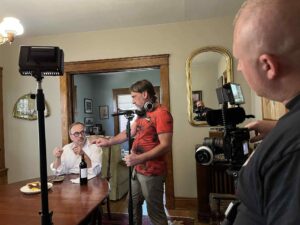
Behind the scenes of “Kingsbury Run,” actor Michael Carrino prepares for a scene with co-directors Brian Jones and Det. Jon Price. [Photo credit: Det. Jon Price]
Since then, numerous documentarians and podcasters have retold the story, fascinated by its enduring mystery. Few of those creators, however, came from Cleveland. “Kingsbury Run,” an independent film co-directed by Brian Jones and Det. Jon Price, is among the exceptions.
The film premiered at the Capitol Theatre in early June. Later that month, it was shown again at Bohemian National Hall as part of Cleveland History Days.
Before the screening, the audience learned more about the Cleveland Torso Murders during an expert panel hosted by My Cleveland History founder Tom Kaschalk.
The panel offered competing theories about what happened and who was responsible. Kaschalk interviewed Price, Cleveland Police Museum director Mazie Adams, and author D.M. Pulley before a live audience.
Price believes Dr. Francis Sweeney was capable of the murders because of his background as a surgeon. He also pointed to a funeral home near the hospital where Sweeney worked, which he believed could have given Sweeney access to cadavers without raising suspicion. “He had ample opportunity,” Price said.
Adams agreed that Sweeney was probably responsible but said the lack of evidence made it hard to build a case. “There’s a reason why it’s an unsolved crime,” she said.
Pulley disagreed, noting differences among the victims, the methods used to kill them, and how their bodies were displayed or hidden. To her, those differences raised the possibility that more than one person was responsible. She questioned whether the evidence was strong enough to support one theory over another. “There are some holes in the theory,” she said.
The discussion raised a broader question: could the Cleveland Torso Murders be connected to similar cases beyond the city? Adams and Price pointed to possible connections to organized crime, while Pulley questioned whether all of the victims were the work of one person. She added that Merylo, the 1930s detective, believed that as many as 50 victims could be connected to the case, suggesting that modern profiling could offer another way to examine the evidence.
The question of who committed the murders remains open to interpretation, and researchers continue to look for answers in the evidence left behind.
While “Kingsbury Run” tells the story of the investigation and those at its center, some of the scenes it depicts include inconsistencies. In the film, a fictionalized account of the murders, Sweeney’s character murders Edward Andrassy, a hospital orderly at the psychiatric hospital where he was a patient. In another scene, Florence “Flo” Polillo approaches Sweeney at a bar before leading her to a secluded alley and killing her. Sweeney then tortures and decapitates the Tattooed Man, whose identity remains unknown. There is no record connecting Sweeney to any of the identified victims, and the circumstances of their deaths remain uncertain.
Although investigators and historians have long suspected Sweeney, who died in 1964, of committing the murders, the case lacked the physical evidence or confession needed to secure a conviction.
The search for answers continues
While most of the 13 Kingsbury Run victims remain unidentified, advancements in forensic genetic genealogy have helped solve cold cases, including New Hampshire’s Bear Brook murders and the Austin, Texas, Yogurt Shop murders.
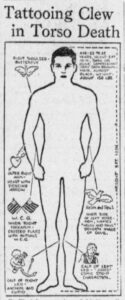
The Coshocton Tribune published this diagram on Feb. 3, 1938, in an effort to identify the “Tattooed Man.” [Credit: The Coshocton Tribune]
One such effort began in August 2024, when the DNA Doe Project announced its partnership with the Cuyahoga County Medical Examiner’s Office to investigate the identities of two victims, known as John Doe #4, the Tattooed Man, and John Doe #6. The announcement was shared on Facebook.
Though no new information about the case has been released, the DNA Doe Project continues its investigation. Kristin Knox, director of media and communications for the nonprofit, said it has released all information it is legally permitted to share. That includes case status, details about the victims, and information about the donor who helped fund the investigation.
Since the discovery of DNA profiling, numerous criminal cases like Washington state’s Cook–Van Cuylenborg murders and Lancaster County, Pa.’s Christy Mirack murder have been solved using forensic genetic genealogy. Those who want to solve the crimes wonder how it could be used in the DNA Doe Project’s investigation. Before a profile can be developed, DNA must be properly collected. That can be difficult when remains have decomposed for years.
Once a DNA profile has been developed, it can be analyzed either through familial DNA searching (FDS) or forensic genetic genealogy (FGG). While FDS has been around for more than 20 years, FGG is relatively new to cold case investigations and offers a far more expansive genealogical analysis.
Law enforcement agencies use public databases like 23andMe and Ancestry to find familial matches and identify criminals. Most notably, in 2018, FGG helped identify Joseph DeAngelo, the Golden State Killer.
Solving cases decades old
The forensic value of DNA wasn’t fully realized until about 50 years ago. Before then, crime scenes were often contaminated, and vital pieces of evidence were unknowingly destroyed.
The case of Kingsbury Run was no exception. Decaying body parts were scattered across Greater Cleveland, where they were exposed to the elements and scavenging animals for unknown periods of time. By the time authorities recovered the remains, much of the evidence had already been compromised.
However, this didn’t make identification impossible. While the four major biomolecules in the human body break down, DNA is unusually stable and can survive long after death.
Ribs, vertebrae, and teeth are among the best sources of DNA. Even after a body has been buried for centuries, the DNA preserved within these bones can remain intact.
“It’s not going to be contaminated with other people’s DNA, even if it had been in a sewer,” explained Dan Krane, Ph.D., professor of biological sciences at Wright State University and president and CEO of Forensic Bioinformatics.
According to Krane, scientists clean the exterior of the bone before drilling into it to collect DNA, a process similar to that used to identify soldiers’ remains from the Vietnam War.
For urgent matters, results can be delivered within a day. Routine DNA testing, however, can take up to a couple of months. Unlike forensic laboratories, these services rely on cheek swabs rather than rib bones or teeth.
To test DNA from the Kingsbury Run victims, the DNA Doe Project will need to work with a specialized laboratory, such as a university or crime lab.
If the DNA Doe Project uses a crime lab, “It’s probably a super low priority,” Krane said. It could be several months before the bones are cleaned and sampled for DNA. As of Nov. 4, 2026, John Doe #4 was listed as “Undergoing testing,” while John Doe #6 remained “Pending.”
Each newly identified victim could do more than put a name to the remains. As Krane explained, identifying the victims could help investigators narrow the pool of potential suspects and better understand what happened in Kingsbury Run.
Related Posts

November 3, 2026
Virginia Voters to Decide Who Regains Voting Rights After Prison
Question 3 would restore voting rights after incarceration without the governor's approval. A federal court ruling has already changed eligibility for many Virginians.
August 28, 2026
Michael Carrino Is Enjoying His Second Act
The Akron-based actor spent the past decade building his career in theater, film, and television. Now, he’s taking on his biggest role yet as Dr. Francis Sweeney in “Kingsbury Run.”