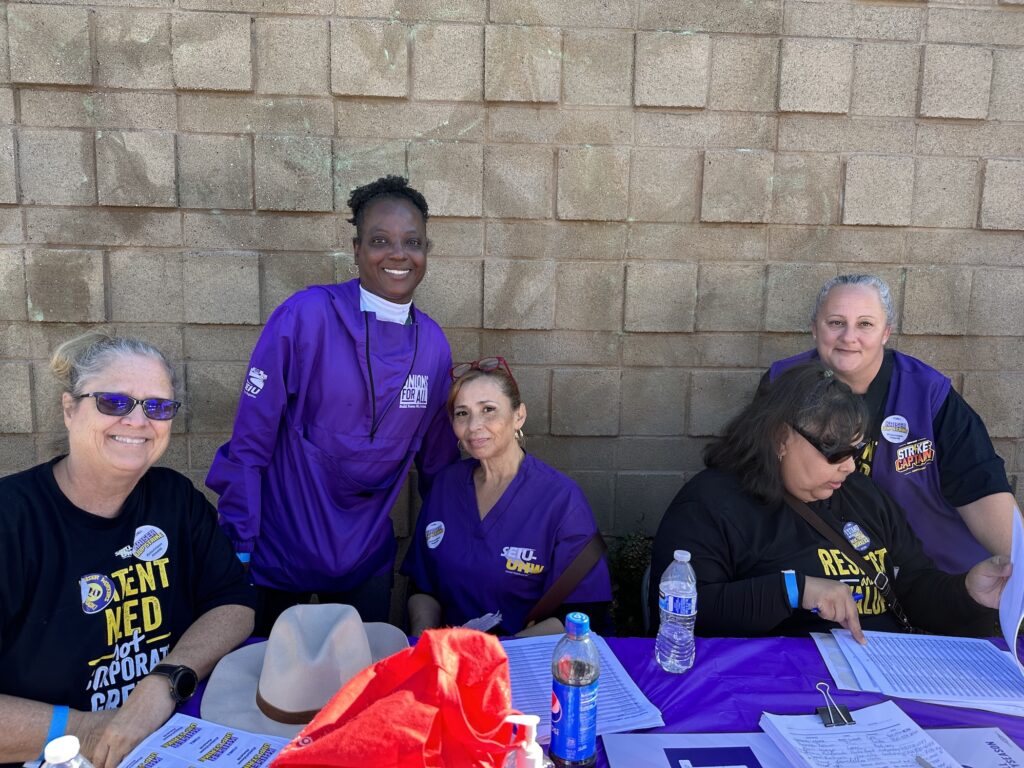
(LOS ANGELES) — Following a three-day strike, Kaiser Permanente employees reached a tentative labor agreement on Oct. 13. Key details of the agreement include a 21% across-the-board raise for all regions, increased minimum wage and shift differentials, and more, according to the union website.
A week earlier, on Oct.5, individuals, families, and whole departments assembled along a busy street in Panorama City for a three-day strike, Together they walked, chanted, and created as much buzz as possible outside the Kaiser Permanente Panorama City medical campus. Service Employees International Union-United Healthcare Workers West provided boxes of signs that simply read “Respect and Value Healthcare Workers”.
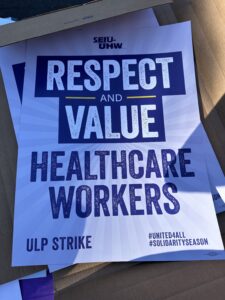
Strike sign provided by the SEIU-UHW [Credit: Christen Keogh]
While there were many points on the negotiating table, a representative of the Kaiser Panorama City Ultrasound Department who participated in the strike said that the dwindling of staff since the start of COVID-19 was the issue that brought her entire department to the picket line.
An ultrasound technician, who asked not to be named, said that patients are waiting six or seven weeks to receive a scan. Because the technicians can only scan one patient at a time, the wait times are strenuous on both the workers and patients. Overtime pay is consistent for those that want it but the incentives are starting to deteriorate.
The technician also conveyed that she is frustrated that Kaiser continues to spend advertising dollars on television commercials to increase enrollment when the staff cannot handle the current patient load.
Janet Oliver, a Kaiser employee who serves multiple departments in central reception, said hers is one of the departments that Kaiser is trying to cut back on.
“My position was first on the list of revenue positions to get rid of,” she told The Click before the agreement was announced… We check [patients] in or they have to use the kiosk…a lot of people don’t want to use the kiosk.”
Asked if she was concerned about losing her job, she paused and said, “I am a little bit concerned yeah…but I am hopeful that they will come to the agreement that we are asking for.”
Oliver is an observer on the local bargaining team and said that members of the union coalition would report at 9:30 am but Kaiser representatives would not come in until after lunch and bring a contract instead of actually negotiating. This inefficiency and disrespect fueled the three-day strike and prompted the proposal of a week-long strike in November.
“Kaiser executives don’t want to and have not come to the table…we have been bargaining since April…now we are at the end of the bargaining and they are saying we were not bargaining with good faith but we were always there,” Oliver says. At the time, there were no representatives from Kaiser to comment.
According to the SEIU-UHW United Healthcare Workers West website, in 2021, workers were promised a “Heroes Bonus” for their efforts during COVID-19. However, it took Gavin Newsom signing it into law over a year later for the promise to come to fruition.
“The work that we do for patient care is not being appreciated,” Oliver says.
With gas prices over $6 a gallon in California, and households struggling through inflation, Kaiser’s frontline workers were demanding better pay.
“We were told that we need to start living to our means…but we are still living check to check…and as a frontline worker we deserve to get a little more respect than that,” Oliver said.
Disclaimer: The author holds Kaiser Permanente insurance.
Related Posts
September 10, 2026
Simon and Fannie’s Story: A Tablecloth, a Family Mystery, and Me
I knew that my great-grandfather and his younger brother immigrated from Poland to the U.S. in 1922 when they were only 19 and 17. I did not know the tragic story of the family who were supposed to come with them until I found a photo behind a picture frame.
September 8, 2026
Who’s Really Running the Water in New Jersey’s Capital City?
Interviews with residents and city leaders, a review of government meetings, and governmental standstills show how few officials have been willing to take accountability for the urgent rehabilitation of the Trenton Water Works.