(TRENTON, N.J.) — Last summer, the New Jersey Commissioner of the Department of Environmental Protection warned that the capital city’s water utility has “an extremely high risk of systemic failure – that the city alone cannot fix, even with the support and the stabilization of the DEP.”
The commissioner was telling the Trenton City Council what they’d known for years when they met on Aug. 18, 2025. The city’s water plant, Trenton Water Works (TWW), is plagued by frequent roof leaks, corroded electrical boxes, a deteriorating central pump, and Legionella bacteria in the water that has resulted in multiple deaths.
Then-Commissioner Shawn LaTourette, was sounding the alarm for a call to action. After years of historic neglect, he told leaders: something must be done, and soon.

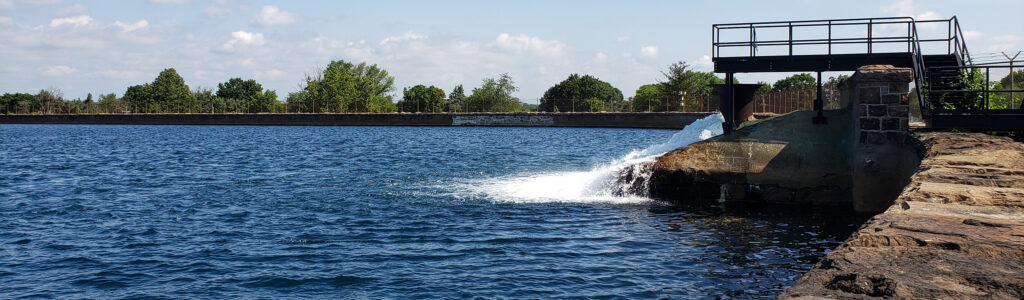
Trenton, a capital city built on the Delaware River, is facing a water crisis of its own. [Credit: Flickr; Peter Miller]
What ensued over the course of that night was a heated debate between city leaders and state regulators — not just over what to do, but over who’s truly responsible for fixing the problems.
The meeting showcased a larger issue that has been playing out in front of residents for years.
Interviews with residents and city leaders, a review of government meetings, and countless governmental standstills show how few officials have been willing to take accountability for the urgent rehabilitation of TWW.
Related: ‘On the Brink of Catastrophic Failure:’ How Long Will Trenton Water Works Keep Working?
And as tensions only continue to rise between local residents, city leaders and state regulators, residents are wondering — a year since the meeting — if much has changed.
The people are speaking, but is anyone listening?
“TWW is scary,” said Ewing resident Bonnie Topley Cooper, describing the water utility she drinks from.
The plant is located in Trenton but also serves the townships of Ewing, Hamilton, Lawrence, and Hopewell, bringing the approximate number of residents served to 225,000. The infrastructure itself is over 200 years old.
“When you pull from [the] tap, it smells; if you’re lucky [it’s] from high chlorine [and not from the] sewer,” Cooper said. “We personally put in a reverse osmosis system because we don’t trust anymore what’s coming out of the tap to drink.”
Dozens of residents that spoke to The Click reported that they too use filters on the water spouts in their home, whether it’s a whole-house filtration system or separate filters for each faucet. In 2026, an under-the-sink filter can cost up to $600, and a whole-house system can run customers up to $10,000.
Some have decided not to drink from the tap at all.
“We’ve been buying bottled water for seven years,” said Tina Tuccillo, a Lawrence resident, in an interview. “We don’t drink it, brush our teeth or cook with it. I hate taking a shower because the mist of the shower can give Legionnaire’s [disease]. We wash clothes with it but I use Lysol disinfectant for laundry in every load.”
Why don’t residents trust the water?
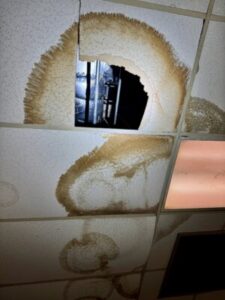
Leaky roofs led to moldy ceilings at Trenton Water Works. [Credit: NJ DEP]
In March, the DEP reported finding some unsavory items floating in the reservoir: fecal contamination, animal bones, swimming waterfowl, and notably, an “unidentified deceased animal.”
The DEP disclosed the information on its website as part of a letter sent to Sean Semple, Director of the Water and Sewer Department. In the letter, the DEP references this as one of several factors making the reservoir out of compliance with state and federal regulations.
This news spread fast through local reports, especially in light of the reservoir’s winter-related impacts, which residents now come to expect every time temperatures drop. In December, due to these impacts, residents were asked to conserve water due to the freezing temperatures and frazil ice in the system.
In February, as snow and ice storms continued to impact the reservoir, Semple released a statement saying the reservoir “remains operational.”
“While recent extreme cold has resulted in water main breaks within our system, as well as in municipalities throughout New Jersey and the Northeast, our crews and contract vendors are actively repairing them around the clock,” he wrote. “Water utilities across the state are managing similar weather-related impacts on water infrastructure.”
Semple did not respond to The Click’s requests for comment.
“The open reservoir is in horrendous condition [with] dead animals, feces, and God knows what else … It’s a toxic soup that they pump into our homes,” Cooper said.
When issues like these pop up, residents might expect to hear from their utility imminently, but this communication often comes too late and too sparsely to be effective, residents say. When the water conservation order was announced in December, the timeline was simply described as “until further notice.”
“I think one of the biggest issues has been public trust and communication,” said Ewing resident Frank Wyckoff in an interview with The Click. “Residents see repeated headlines about water quality concerns, infrastructure problems, oversight disputes, and political fighting, and it creates the perception that nobody is fully in control.”
“Even when improvements are being made behind the scenes, the communication to the public often feels reactive instead of proactive, which damages confidence further,” Wyckoff said.
Speaking to residents in the TWW service area came at a confounding time early this year. In January, newly-elected governor Mikie Sherrill appointed a new NJ DEP commissioner, Ed Potosnak.
At a statehouse budget hearing in April, Potosnak defended Sherrill’s proposal to cut to TWW’s budget by $2 million. He told legislators that the state solicited bids last year to bring in new, specialized management at the plant. But, the state received no bids, he said.
“It’s ultimately Trenton Water Works’ responsibility, a clean, reliable drinking water supply,” Potosnak said at the meeting.
Who’s in charge of TWW, legally?
If residents can’t trust the water that’s coming out of the tap, they say they wonder if they can’t trust the people in charge of it, either.
TWW is owned by the city of Trenton, even though it has customers in four additional suburban towns. It is not an independent facility, meaning that infrastructure repairs, requests for new chemicals and all proposed issues must be brought before the Trenton City Council for approval.
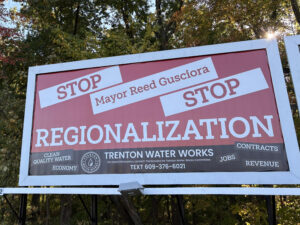
Despite a push from the DEP to regionalize the water utility, residents are pushing back, worried about the potential loss of city revenue and jobs. [Credit: Lara Becker]
She described the city council as a system of checks and balances for the utility, saying that they are there to provide oversight on improvements. She does not agree with critics like former City Council member Robin Vaughn, who describes the current council as TWW’s “board of directors.”
She said that council members can only do so much.
“The mayor, at the end of the day, decides what he’s going to act on and not act on,” she said.
The mayor is in charge of grand-scale and budget oversight for TWW projects. But, his mayoral involvement isn’t water-specific — it’s simply an extension of one of many city departments which each have their own sets of issues.
Mayor Reed Gusciora, who is currently running for re-election, has expressed interest in exploring the regionalization of TWW. According to studies into the logistics, this could mean re-structuring the utility as a shared authority between all five towns, creating TWW as an independent entity, or allowing a third party to step in for assistance.
Gusciora has faced pushback from residents of all service area towns, as well as city council members, who are worried about loss of revenue and jobs.
“I was in favor of the regionalization study as a way for council to get that information from the beginning. I still am,” said Gusciora in the Aug. 18 city council meeting. “But it shouldn’t be forced on Trentonians, as the commissioner made clear tonight.”
Since the DEP has been made aware of increasing issues at the plant, they’ve also stepped in to personally monitor the plant since 2022, under a mandatory Unilateral Administrative Order. The DEP frequently posts updates to TWW movements, letters to TWW directors, and proposed changes for residents to view.
And then there’s the people at the plant itself — directors, management, engineers, water testers, and lab technicians.
The parties are tasked with working together to solve any issues efficiently. For instance, a TWW director can be appointed by the mayor, and then confirmed by the city council. They are meant to work in tandem like an assembly line. But, they’re not exactly known for getting along.
One city council member at the Aug. 18 meeting told commissioner LaTourette that his proposed changes would “penalize Trenton residents for failures that occurred under DEP watch.” LaTourette responded: “Oh, you’ve gotta be kidding me. No, that’s absurd… and quite frankly, it’s a bit shameful.”
The place and time in between these disagreements is where residents —and even employees — can get lost.
A history of personal and personnel strains
Conflict has also been brewing within the organization itself in recent years.
There’s one personnel event that stands out amongst the rest — when Cesar Lugo, a former TWW water tester, was found to have falsified records for a series of 13 months from 2022 to 2023. This, in part, could have led to the Legionella outbreaks that resulted in multiple deaths in the same years.
The incident wasn’t discovered by the city or TWW — they were only tipped off by Lugo’s neighbor, who complained that his city vehicle never seemed to leave home. Lugo was indicted on criminal charges in May of 2025. TWW was fined $235,000 for violating the New Jersey Safe Drinking Water Act, and for taking so long to discover the fraud.
And, there’s evidence to prove this was not an isolated event. In January 2025, a Technical, Managerial and Financial (TMF) report of TWW was conducted by a third party contractor. The report says that in 2019, a laboratory technician was found to have falsified sample data. The employee was not criminally charged — or even fired.
“An internal investigation concluded that this employee was under-trained, and rather than being terminated, was transferred to a different position within the City government,” the report said, calling this instance and Lugo’s actions a “pattern.”
And today, a lot of concerns are directed at the topic of hiring. In the past eight months, there have only been two TWW job listings posted on the city’s website.
The January 2025 TMF report, which also discusses staffing, noted that there are insufficient employees to fill all roles, which has led to burnt-out operators and undertrained employees.
Where TWW goes from here
In October, city council member Jasi Mikae Edwards passed an ordinance to create an ad hoc committee specifically for TWW issues. The good news about the ad hoc committee is that it is able to speak directly with TWW leaders on a regular basis, and communicate about the issues head-on. The bad news is that the meetings are closed to the public.
Edwards had been pushing for the creation of the ad hoc committee — and to start making actionable changes — since January 2024, but the members of council disagreed on these issues internally as well.
When it comes to approaching the improvements to TWW, council members had expressed concerns in the past about rushing the process. To those colleagues, Edwards wrote in an op-ed in a local publication: “Respectfully, this is not being rushed, it’s being rescued.” Edwards did not respond to The Click’s request for comment.
But when it comes to traction on a more daily basis, residents look to leaders in their own communities.
Activism from community members
A year since the August meeting, has anything really changed? Marc Leckington, a Trenton resident, has a simple answer to that question: “no.”
Leckington has taken it upon himself to become his own type of leader – championing for change daily in terms of TWW reform. He’s one of many who feel that change simply isn’t moving fast enough, especially for a system that’s been called “on the brink of failure.”
Leckington runs a Substack blog entirely dedicated to reports of TWW happenings, new related resolutions and stories that are often hidden to the greater public.
Frank Cusack is a Hamilton resident and another community activist. He likened the Aug. 18 city council meeting to a Chief CEO having to show face at a low-level staff meeting. When the NJ commissioner of the DEP has to publicly address issues in your city, he said, something clearly isn’t right.
For a lot of members in the service area, the direct DEP oversight and the Aug. 18 city council meeting was a turning point in terms of paying attention.
Cusack now refers to it as “that meeting.” He started a change.org petition called “Vote No Confidence in Trenton’s Water Utility Management,” and runs a Facebook group called “Coalition for HELTHy Water.” In these groups, as well as many other Facebook collectives, residents commiserate about their own personal distaste for the water.
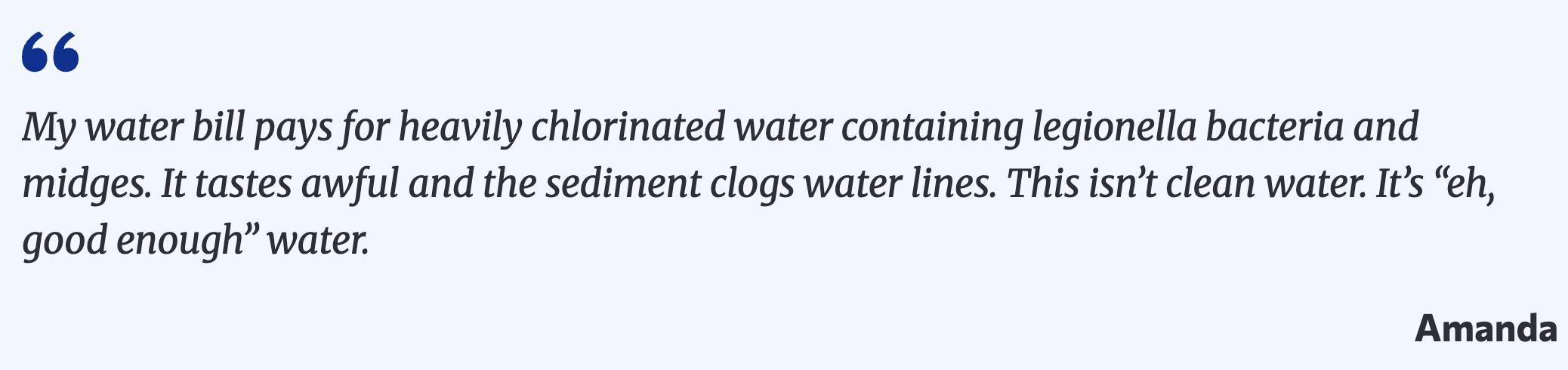
A comment Change.org’s petition to “Vote No Confidence in Trenton’s Water Utility Management.” [Credit: Change.org]
The parties in charge seem to be able to identify problems, but creating actionable solutions is far less frequent.
Taking time out of their day to keep Mercer County residents informed, making issues known, and lobbying for a better way forward is something that Leckington and Cusack want to provide for their communities.
Thinking back to simpler times, Cusack spoke fondly about a Facebook group called “Trenton Memory Lane,” where people post photos of retro Trenton buildings, businesses that no longer exist, and kids playing all the way down Olden Avenue. Trenton was once a city of booming industry – pioneers in the field of industrialization, even.
But now, he notes “it’s becoming the status quo that there’s no change” when it comes to fixing the water utility, one of the area’s most vital resources.
“So many of us have a feeling of taxation without representation,” Cusack says. And Leckington adds, “People are not prioritizing things at the water department as they should be.”
Related Posts
September 10, 2026
Simon and Fannie’s Story: A Tablecloth, a Family Mystery, and Me
I knew that my great-grandfather and his younger brother immigrated from Poland to the U.S. in 1922 when they were only 19 and 17. I did not know the tragic story of the family who were supposed to come with them until I found a photo behind a picture frame.
August 31, 2026
Ferry Tale: Aboard the Tacoma #1
Every day, thousands of passengers cross Puget Sound without thinking much about the crews who make their journey possible. A day on the water with the ferry workers shows how routines, relationships, and quiet expertise keep one of the nation's largest ferry systems running.